What key difference exists in the upstream workload between a mass-burn facility and a Refuse-Derived Fuel (RDF) facility?
Answer
RDF facilities require labor dedicated to pre-processing steps like shredding and drying the waste
RDF requires substantial labor before combustion to create a uniform fuel product, while mass-burn handles raw, unsorted waste directly.
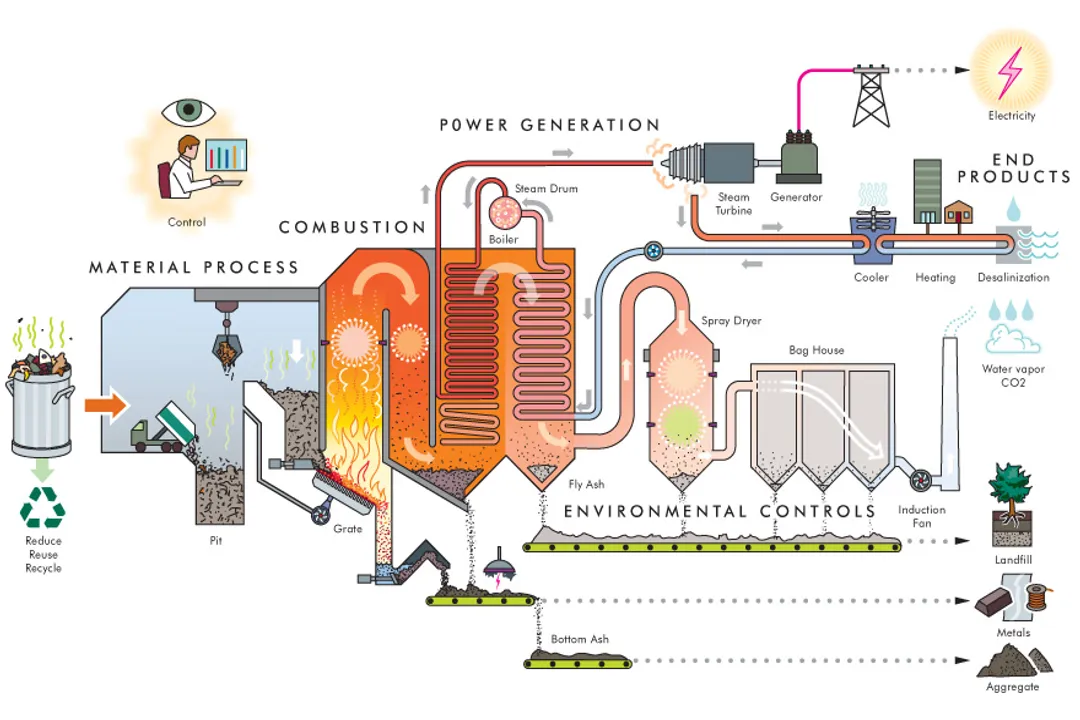
#Videos
How Does a Waste-to-Energy Plant Work and What are the Benefits?
Related Questions
What is the primary function of overhead cranes regarding incoming municipal solid waste in the bunker?What is one of the two critical purposes for maintaining extremely high furnace temperatures (often exceeding $1,800^ ext{o} ext{F}$)?How do the grates inside the furnace facilitate complete waste combustion?Which method is used in the Air Pollution Control (APC) system to remove acid gases like $ ext{SO}_2$ and $ ext{HCl}$?What operational insight does tracking the differential pressure across a filter bag provide to process monitoring staff?What is the typical handling protocol required specifically for fly ash, differentiating it from bottom ash?In a system designed for Combined Heat and Power (CHP), where is the lower-pressure steam redirected after the initial turbine stage?What key difference exists in the upstream workload between a mass-burn facility and a Refuse-Derived Fuel (RDF) facility?What equipment is used, along with eddy current separators, to recover non-ferrous metals from bottom ash?What regulatory activity forms a constant background task for WTE plant employees?What is the role of primary air in the combustion system?