How do you work in workforce equity systems?

Working in workforce equity systems begins with a fundamental shift in perspective: moving away from simply matching individuals to any available job toward designing an economy where all jobs are good jobs and opportunity is fairly distributed regardless of background. [2] Workforce equity is not about treating everyone the same—that is equality—but about recognizing that historical and systemic barriers mean different employees need different resources and support to achieve fair outcomes. [4][5] In essence, it is about eliminating racial gaps in employment and income so that the workforce mirrors the general population across all skill and pay levels. [2][4]
For general readers or practitioners, understanding how to work in these systems requires looking at three distinct, yet interconnected, levels: the high-level system redesign, the policy and partnership structures that govern the system, and the day-to-day actions within the workplace itself.
# System Redesign Pillars

When redesigning an entire workforce development system to place equity at its guiding value, proponents suggest a four-pillar approach is necessary, moving beyond the traditional focus solely on individual upskilling. [6][7] This design acknowledges that economic mismatches are multidimensional, encompassing skill gaps, geographical constraints, social networks, and structural biases in hiring and pay. [6]
# Sharing Risk Equitably
One crucial element of structural redesign involves overhauling the financing model. [7] The current structure often relies on government-to-citizen funding transfers, where quality can suffer if investment lags. [7] A proposed solution is to establish a dedicated, future-proof Workforce Equity Trust Fund (WETF). [7] This fund is intended to create a steady revenue stream dedicated to improving job quality and enshrining worker protections into law. [7]
Financing this could involve an employer-financed mechanism, drawing inspiration from other developed nations where employers hold a greater obligation for workforce adaptation. [7] For instance, a minuscule levy, such as a fraction of a percent on the gross receipts of the largest corporations, could generate billions annually for the system. [7] This approach is rooted in the idea that businesses benefit from a more educated, stable workforce, making the contribution a shared responsibility that enhances their long-term productivity. [7] This contrasts with the common, more reactive model of funding that often dictates that training only occurs during recessions. [7]
# Standardizing Support
The second pillar involves standardizing and making portable a comprehensive suite of wraparound services and core employment benefits for every worker through the WETF. [7] While services like transportation and childcare are sometimes permitted under existing laws, like the Workforce Innovation and Opportunity Act (WIOA), research indicates that many needs remain unmet for job seekers facing barriers. [1][7]
Equity demands that these supports—including health insurance, paid family leave, and assistance with housing—follow the worker, rather than being tied only to a specific, temporary training program or job. [7] A powerful mechanism for standardizing quality and wages is leveraging or incentivizing the formation of wage boards. [7] These boards, which bring together employers, workers, and the public, can negotiate minimum workplace standards, including wages and benefits, helping to raise the floor across an entire industry rather than relying solely on government mandates. [7] Furthermore, embedding targeted hiring and apprenticeship utilization requirements into public spending projects—such as requiring a percentage of work on state-supported construction projects to be done by apprentices—can drive structural change within the system. [7]
# Data Accountability
The third pillar insists on moving beyond the traditional performance metrics of the WIOA, which often focus narrowly on short-term employment rates and median earnings after program exit. [7] To truly work in workforce equity, accountability systems must incorporate multiple measures of job quality. [7] Drawing from OECD frameworks, this includes assessing:
- Earnings Quality: How earnings meet regional cost-of-living needs. [7]
- Labor Market Security: The risk of job loss and its economic cost. [7]
- Quality of the Working Environment: Noneconomic factors like time pressure and physical health risks. [7]
Implementing this requires systems-level data analytics, perhaps through an accountability dashboard that uses data sources like the Equal Employment Opportunity Commission (EEOC) filings, which already disaggregate employee counts by job category, pay band, race, ethnicity, and gender. [7] Simply tracking if a worker finished a certificate is insufficient if the resulting job offers no stability or growth; research has shown that training completion doesn't always guarantee a job that can adequately support a family. [6][7] It becomes necessary to look at how institutional structures, rather than just worker skills, influence outcomes. [6]
# Multistakeholder Governance
Finally, the system must shift its governance away from the historic employer-majority model toward inclusive, multistakeholder partnerships, often called tripartism. [7] In many countries, national workforce policy requires joint coordination between government, labor representatives (unions), and employers. [7] While current US law often requires a private sector majority on Workforce Development Boards (WDBs), successful equity-oriented models often adopt a tripartite structure where all three parties have equal footing. [7] This ensures that decisions on training and employment standards balance market needs with social factors like fairness and regional cost of living. [7]
Labor-Management Training Partnerships (LMTPs) exemplify this, demonstrating that when worker representatives and employers jointly manage training trusts, worker interests remain central to development and quality improvement. [7] This structural inclusion is what can help distinguish a system focused on genuine equity from one that prioritizes efficiency or employer demands alone. [7]
# State Actions for Equity
At the state level, governors and policymakers can begin implementing these systemic changes through a series of targeted strategies designed to dismantle barriers embedded in institutional structures. [1]
First, establishing a dedicated group—like a task force or a cabinet-level position—is vital for ensuring sustained action and accountability toward shared equity goals. [1] This signals that equity is a priority that transcends any single administration. [1] Following this structural commitment, the system must define what equity means for its specific context, clearly identifying the historically excluded groups the work intends to serve. [1] Colorado, for example, defined racial equity as achieving a state where race or immigration status is no longer correlated with one's outcomes. [1]
With definitions and leadership in place, the next step involves setting measurable goals for service delivery and tracking specific metrics to close access and equity gaps. [1] For example, goals might target expanding equitable access to vital supports like childcare or reducing transportation barriers. [1]
The continuous work involves rigorous data analysis. This means going beyond basic demographic tracking to actively gather data on the barriers preventing access to programs and then conducting formal equity analyses to pinpoint service gaps across different populations. [1] States like Minnesota and Missouri have developed dashboards to show real-time activities and outcomes disaggregated by race, ethnicity, and geography. [1]
Targeting services to the populations facing the highest hurdles—such as formerly incarcerated individuals, people with disabilities, or workers of color—is also a key operational focus. [1] Delaware established an office specifically to eliminate gender-based bias, while other states have piloted coordinated service delivery for veterans or offered subsidized childcare to job seekers. [1]
Crucially, policy is only as effective as its implementation. Therefore, ongoing engagement with stakeholders, particularly those historically left out of planning (like those with limited internet access or those re-entering society), is necessary to gather qualitative data on program operation. [1] This feedback loop informs the examination and modification of internal policies and procedures that may inadvertently contribute to inequity, such as limiting job center operating hours or restrictive on-site rules. [1] Finally, system leaders must strengthen partnerships, especially with organizations possessing specialized community knowledge. [1]

# The Frontline: CBOs and Workplace Practices

While state policy sets the direction, the practical reality of working within workforce equity systems often falls to Community-Based Organizations (CBOs). [10] CBOs are uniquely positioned because they are nonprofit, grassroots institutions deeply embedded in their neighborhoods, often staffed by people with lived experience of the very barriers they seek to overcome. [10]
CBOs act as the essential connective tissue, meeting people "where they are" through trusted local venues like faith-based organizations or local schools. [10] Their core functions in the ecosystem include:
- Outreach and Engagement: Serving as the first, and sometimes only, point of contact for those excluded from formal systems. [10]
- Wraparound Supports: Directly tackling immediate barriers like housing instability, childcare gaps, and mental health needs, which traditional job placement programs often overlook. [10]
- Career Navigation: Offering individualized case management through complex systems. [10]
For sustainable impact, CBOs cannot operate in isolation; they require strong, sustained partnerships with workforce boards, community colleges, and employers, built on mutual respect and a shared commitment to equity. [10] When institutions treat CBOs as equal partners and invest in their administrative capacity—not just their direct service delivery—the entire system becomes more resilient. [10]
# Micro-Level Equity Efforts
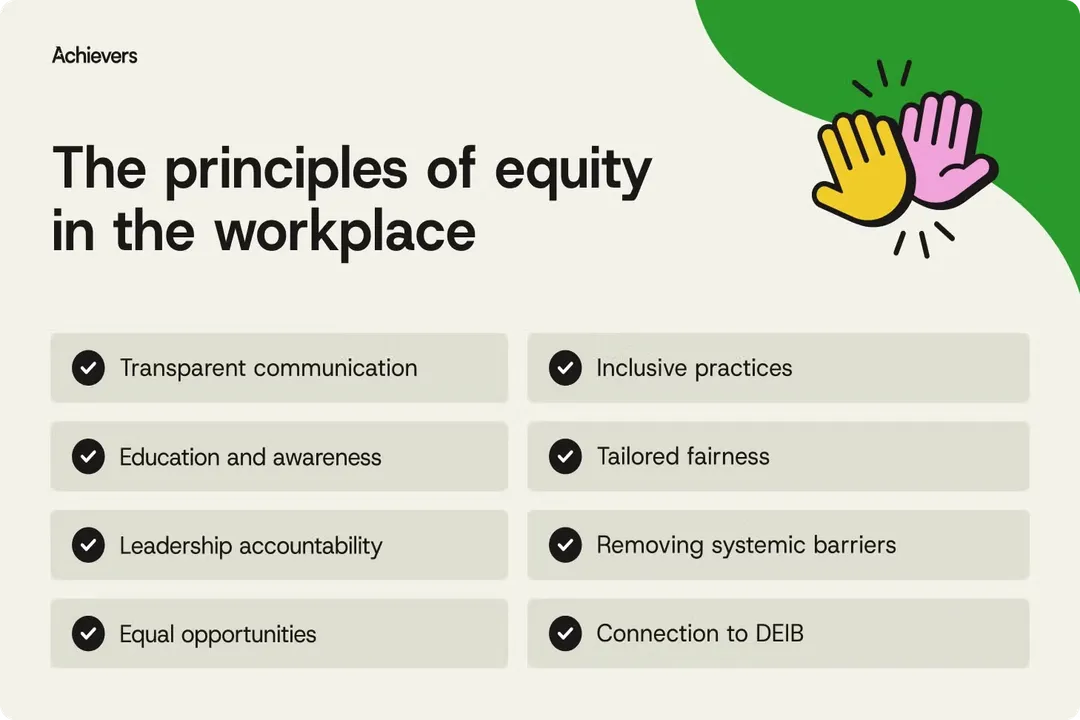
Within the private or public employer setting, working for equity means translating systemic goals into concrete, measurable organizational practices across the employee lifecycle. [8]
In Recruitment and Hiring, the process must actively counteract implicit bias. [8] This involves using skills-based hiring, prioritizing demonstrated abilities over specific degree requirements, which opens doors for those without traditional educational access. [4][5] Furthermore, implementing practices like blind resumes—redacting identifiers like age, gender, or race—can reduce unconscious bias during initial screening, ensuring candidates are judged only on relevant characteristics. [8]
Compensation transparency is non-negotiable. [5] Historically, basing new salaries on prior compensation perpetuated existing pay disparities, particularly for women and people of color. [5][6][8] Equity requires clarifying the criteria for base pay and raises, focusing on job duties, experience, and location rather than salary history. [8]
For Career Development and Promotion, equity means ensuring access to advancement opportunities is transparent and fair. [5][8] If data shows certain groups are underrepresented in leadership—for instance, if a company's workforce is 45% people of color but none are in leadership—it signals a need for targeted support, such as executive sponsorship programs, rather than simply waiting for parity to happen naturally. [8] Providing equitable access to resources means considering physical accessibility (like wheelchair ramps) and digital accessibility (like accurate closed captions). [5]
# The Challenge of Intent Versus Implementation
A recurring theme in the effort to implement workforce equity is the tension between organizational intent and actual resource allocation or follow-through. [9] While many organizations hire equity professionals to signal commitment, there is often resistance to the deep structural changes required to back up those commitments. [9] Some observers note that when systemic issues are recognized, management may look for positions to manage the perception of change—focusing on PR, external surveys, or superficial events—without addressing the underlying processes. [9]
For instance, a system focused too heavily on individual upskilling without addressing structural issues risks becoming a funnel that concentrates disadvantaged job seekers into low-wage roles, regardless of credential attainment. [6][7] The very structure of the public workforce system, often driven by a "free-market approach," can create tensions between equity and efficiency, as training providers must compete for customers who may lack the resources or knowledge to navigate complex bureaucracy effectively. [7] A genuine approach to workforce equity, therefore, is not just about adding training slots but about reorienting the entire system to prioritize job quality above all else. [6][7]
If an organization seeks to build a truly equitable workforce, it must integrate equity into its everyday culture, not treat it as a side program. [5] This means looking honestly at how implicit bias manifests in day-to-day interactions, such as managers favoring on-site employees for assignments due to comfort or familiarity, creating a subtle but persistent barrier for remote or less visible staff. [8] The work involves cultivating a safe environment for open discussion and accepting that achieving equity is an iterative process that requires constant re-evaluation of practices, even well-intentioned ones. [5]
For state and local systems, operationalizing equity means that when gathering data to track progress, practitioners must choose metrics that reward inclusive policy adoption. [7] For example, in assessing partnerships, a mere count of partner organizations is less valuable than an indicator of shared accountability—tracking whether joint goals, specifically those designed to improve outcomes for marginalized groups, are actually being met through the partnership's collaborative efforts. [7] This level of granular, performance-based accountability, which measures system success for the worker rather than worker success in a program, is how practitioners ensure they are building a different reality, not just describing the current one. [6][7]
Related Questions
#Citations
Advancing Workforce Equity: A Guide for Stakeholders
7 exceptional examples of equity in the workplace - InStride
Developing a More Inclusive and Equitable Workforce System
Workforce Equity - Enboarder
A guide to equity in the workplace - Achievers
A Design for Workforce Equity - Center for American Progress
Workforce Equity: Building an Economy That Works for All
Creating a More Equitable Workforce System: Opportunities for ...
What exactly do people even do everyday in Diversity and Equity ...
The Heart of Workforce Equity: Community-Based Organizations ...