What Is Career Stability?

Career stability fundamentally describes the capacity of an employee, or a collective group of employees, to retain the same job over an extended period. [5] It is less about the immediate moment and more about the continuum of employment—how long a worker will remain in a particular role without significant changes or interruptions. [1][2] This concept contrasts sharply with earlier career paradigms where long tenure, often celebrated with tokens like a gold watch after forty years, was the standard expectation. [1] Today, the professional landscape is structured differently; many roles are filled via external recruitment, and rapid technological shifts mean that the tasks performed in a job can change drastically even if the title remains the same, challenging the traditional definition of staying put. [1]
# Tenure Permanence

To truly understand career stability, it helps to look at its precise dimensions as viewed through labor statistics. Stability is not a single metric but a multifaceted concept involving both duration and consistency. [2]
One dimension is duration of employment, often referred to as tenure. A general measure here might be the proportion of workers who have been in their current job for a minimum of three years. [2] This speaks directly to the "keeping the same job for a long time" aspect. [5]
The second dimension is regularity. This addresses the consistency of engagement in paid work or income-generating activities while maintaining that overall continuous duration of employment. [2] For employees who are not strictly permanent (like independent contractors or the growing number of contingent workers), identifying stability requires looking at the regularity of their income flow and workload, as they lack the explicit end date guarantee associated with standard employee permanence. [2] Even forms like gig work, characterized by very short-term tasks paid per unit of work without steady employment assurance, exist at the extreme end of the instability spectrum. [2]
When we map these concepts—stability, security, and growth—it becomes clearer where stability sits in the modern career equation.
| Concept | Primary Focus | Time Horizon | Core Benefit | Key Risk |
|---|---|---|---|---|
| Career Stability | Duration in role/company | Long-term | Predictability, deep expertise [3] | Missing out on rapid external raises [3] |
| Job Security | Certainty of continued employment | Short-term | Peace of mind, reduced anxiety [1][9] | Can be psychological, not actual [1] |
| Career Growth | Skill advancement, role change | Medium-term | Higher salary, new challenges [3][7] | Unpredictability, job hopping perception [7] |
Stability, therefore, is built on the foundation of a reliable working relationship, distinct from the feeling of immediate safety provided by job security. [8]
# Security Feeling
It is easy to conflate career stability with job security, yet they serve different psychological and practical needs. Job security centers on an employee's feeling about the likelihood of retaining their current job. [1] It is inherently short-term, focusing on avoiding immediate redundancy or firing, often rooted in the belief that the work done is essential to the company, even if layoffs occur. [1] This feeling is often described as psychological security—the sense of "I won't be fired tomorrow". [1]
Actual job security, while rarer, might apply to tenured university professors or roles protected by stringent government regulations, such as in France, where cause must be proven before termination. [1] For the vast majority, however, security is a state of mind influenced by performance, skills, the company's financial health, and employment contracts. [1]
While a stable job should be secure, the reverse is not always true. [1] Someone can feel highly secure because they are doing necessary work, yet their role might lack stability if the company culture strongly favors external hiring for advancement, meaning progression requires leaving. [1] If an employee feels secure but their skills are becoming obsolete due to technological advancement, that security is brittle. [1][6] Employers increasingly value adaptability and the presence of in-demand hard skills, like those related to cybersecurity or data analysis, because technical ability directly drives productivity and competitive results. [6] A worker whose job is secure but whose skillset is stagnant is not truly stable in the long-run sense of the word. [1]
When job security is absent, the effects cascade. Employees experience stress and anxiety, leading to lower engagement, increased gossip, decreased focus, and a breakdown of trust in management. [1] Conversely, organizations that successfully instill job security see benefits like higher engagement (over 85% of job-secure workers are engaged) and improved retention, as employees are more willing to invest effort today if they believe they will be employed tomorrow to reap the rewards of that investment. [1]

# Growth Tension
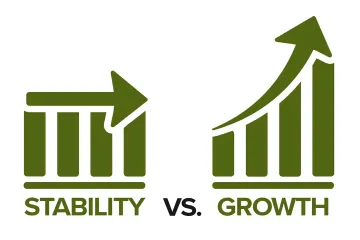
The pursuit of stability exists in direct tension with the pursuit of rapid career growth. For years, the accepted wisdom suggested that moving jobs every eighteen months signaled ambition and was a necessary tactic for increasing salary and gaining diverse skills. [3] Job-hoppers frequently see salary increases—reports suggest job changers average a nearly 10% hike compared to cost-of-living adjustments for those who stay. [3] This path cultivates adaptability and a wide network, which are assets in a changing market. [3]
However, the economic uncertainty characterizing recent years has caused many professionals to reconsider this calculus. [6] The constant cycle of searching, interviewing, and then facing potential layoffs has created significant emotional labor for job seekers, leading many to prioritize "The Big Stay" for the sake of predictability and peace of mind, even if it means staying in roles they might have previously outgrown. When the market is volatile, the risk associated with leaving a secure role for an uncertain but potentially higher-paying one feels greater.
For many, the debate becomes: do I chase the financial rewards of growth and risk burnout or redundancy, or do I settle for the predictability of stability? Career stability, in this context, provides better retirement packages, stronger long-term leadership opportunities within one firm, and emotional grounding through consistent work relationships. [3][7]
The key insight here is that modern stability is not about never moving; it is about intentionality in movement or remaining planted. If a worker chooses stability, they must still remain adaptable. If they choose growth through hopping, they must have a strategic timeline and clear reasons for each move to counter employer skepticism. [3]
I often see professionals in mid-career wrestling with this balance. For instance, a highly skilled software engineer might leave a fast-paced role known for innovation (high growth, low stability) for a slower-moving firm that guarantees current projects will continue for the next year (high stability, lower immediate excitement) because the emotional toll of repeated layoffs became too exhausting. Their personal definition of success shifted from rapid ascent to reliable footing.
# Market Factors
The external environment heavily dictates the perceived value of career stability. Economic uncertainty, business instability, and geopolitical factors significantly influence how employees view their long-term prospects. [6] When large corporations announce mass layoffs, it generates widespread concern, making employees question their own safety regardless of tenure. [1][6] This environment pushes job security and stability higher on the list of desired employment characteristics. [6]
Specific industries also offer different avenues for stability. For example, the call center industry, often stereotyped as having high turnover, can, in reputable organizations, provide significant stability. [9] This stability stems from offering consistent work schedules and dependable income, which aids in long-term personal and household budgeting—a clear benefit over contract or freelance uncertainty. [9] Furthermore, certain call centers prioritize internal training and clear promotion tracks, turning agent roles into viable, secure career paths rather than mere stepping stones. [9]
The way companies manage layoffs also affects the perception of stability. If a company engages in "dumbsizing"—letting go of too many skilled workers out of panic—it harms its own operational capability and signals instability to remaining staff, further eroding trust. [1] Transparency from management during uncertain times is vital; rumors are often more damaging than the truth, and clear communication can minimize the negative effects of insecurity. [1]
# Building Tenure
Achieving career stability in a fluctuating environment is an active process that requires strategic investment in oneself, often aligning with what employers value most. [6] It requires accepting that your career path may be non-linear—a series of shifts and turns rather than a straight climb. [6]
The first proactive step involves upskilling. Employers value a combination of technical ability (hard skills) and interpersonal/adaptive abilities (soft skills). [6]
Hard skills provide the measurable technical foundation—think cybersecurity, data analysis, or cloud computing expertise—which makes an employee directly valuable for current business needs. [6] If machines take over routine tasks, the remaining human work leans toward creative and strategic responsibilities, demanding competence in working with new technology, like GenAI. [6]
Soft skills act as the "glue," determining long-term success in collaborative roles. [6] Skills like Emotional Intelligence (EQ), adaptability, creative thinking, and conflict resolution ensure an employee can navigate complexity and work effectively with both human colleagues and AI systems. [6]
To structure this self-improvement, one could conduct a simple Career Resilience Audit every quarter:
- Skill Gap Analysis: List the top five skills needed for the next level role you aspire to (even if it's outside your company). Cross-reference this with your current proficiency. Any gap indicates an upskilling target. [6]
- Transferable Mapping: Identify three specific accomplishments from your past two roles that showcase adaptability or problem-solving, regardless of the job title. These are your stability anchors for future interviews. [3]
- Internal Visibility Check: Have you proactively discussed career pathing with your manager in the last six months? If not, schedule that conversation. Demonstrate to your employer that you are prioritizing development, as companies that support career and skills development report higher employee retention. [6]
Furthermore, stability can be cultivated by showing commitment where you are. [7] Taking advantage of internal training and advancement opportunities sends a clear signal to the employer that you are invested in their future success, creating a win-win scenario where they develop necessary skills in an existing, reliable employee. [6] When internal mobility exists, employees can climb the ladder without having to leave, reinforcing stability through consistent internal contribution. [1] Even if the ultimate outcome is a move elsewhere, this preparation ensures that any transition is strategic, leveraging new skills rather than being forced by circumstance. [6] In essence, achieving modern career stability is about making yourself indispensable right now while simultaneously building a portfolio of skills that ensures your value tomorrow, regardless of where you are employed. [1]
Related Questions
#Citations
JOB STABILITY definition | Cambridge English Dictionary
Job Hopping vs. Career Stability: Which is Better for Your Career?
Stability and permanence in employment - UNECE
How to Find Job Stability in an Unstable Job Market - LHH
Stability vs. Growth: Making Decisions About Your Career Trajectory
The Role of Job Stability and Security in · Next Phase Recruitment
Job Stability Is the New Career Goal, Here's Why - Morgan McKinley
What is Job Security? - Growthspace
Why Job Stability Matters—and How Call Centers Provide It