What is the meaning of career stability?
Career stability often conjures images of long service at a single company, a predictable paycheck arriving every two weeks, and a low likelihood of unexpected termination. [1][5] Fundamentally, it speaks to the degree of certainty an individual has about retaining their employment over a foreseeable period. [8] This sense of security is frequently financial, but it also carries an emotional weight, suggesting a known environment where the rules of engagement—the work required, the colleagues, and the direction of the business—remain relatively consistent. [3][5] For many, stability is intrinsically linked to low turnover, meaning the job itself is secure within the organization. [5]
This perception often leads to defining stability by tenure. If someone has stayed in the same role or with the same employer for many years, they are generally assumed to possess a stable career path. [2] However, that simple measure masks deeper complexities. What one person views as a fortress of employment, another might see as professional stagnation. [3] The very definition hinges on the career goals of the individual evaluating the situation. [6]
# Core meaning
At its most basic, job stability signifies a reliable income stream and a consistent work setting with minimal job loss risk. [1] This reliability is what attracts many people, particularly those focused on long-term personal financial planning, such as building toward financial independence, where predictable cash flow is paramount for modeling future success. [7] When considering stability, people are looking for reduced uncertainty regarding their professional standing. [8]
The opposite of this is frequently associated with job hopping—frequently changing employers, which can signal instability or, conversely, aggressive self-advancement. [4] Yet, stability is not just about avoiding movement; it's about the quality of the footing you stand on. A role that guarantees employment for the next five years but offers no opportunity for skill acquisition may provide short-term comfort but undermine long-term security if the entire industry begins to contract. [7][9] The concept demands looking past the current contract and assessing the inherent durability of the position itself. [8]
# Stability Versus Growth
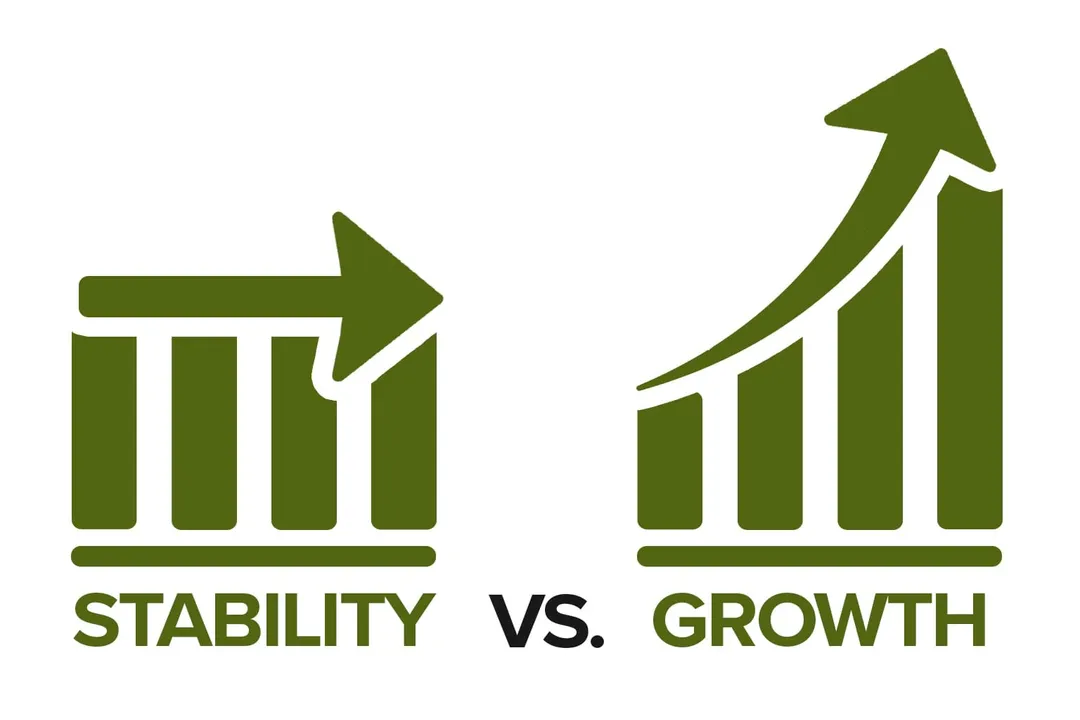
A defining characteristic of stability discussions is the trade-off, or perceived trade-off, with career growth. [3] Stability champions consistency, predictability, and security. [3] In this mindset, a safe harbor is preferred over navigating unknown waters in pursuit of a promotion or a higher salary bracket elsewhere. [3] The stability seeker values knowing their next steps and feeling emotionally secure within their current sphere. [3][5]
Growth, on the other hand, requires risk. It demands learning new competencies, taking on unfamiliar projects, and frequently switching environments to accelerate advancement. [3] For an employee driven by growth, maintaining the status quo—even a comfortable one—is a form of career regression. [3] The difficulty arises because these two ideals often pull in opposite directions. A promotion might increase pay but place the employee in a higher-stakes leadership role where the consequences of failure are more severe, thus decreasing immediate job security, even as professional standing improves. [3] Understanding which preference outweighs the other is central to interpreting one's own career needs. [6]

# Subjective Security
It is crucial to recognize that career stability is highly subjective. [6] The required level of assurance shifts dramatically based on an individual's life stage and financial standing. For a recent graduate burdened with student loan debt, stability might mean simply maintaining any full-time income source to meet monthly obligations. [7] For a mid-career professional supporting a family, stability translates to health benefits, pension contributions, and an undeniable long-term contract. [5]
Consider the perspective of someone targeting financial independence (FI). Their definition of stability isn't about company loyalty; it’s about guaranteed income flow sufficient to cover their target annual spending, regardless of where that income originates. [7] If a high-paying, but volatile, contract job provides 60,000 government job, simply because the higher income accelerates their timeline to early retirement. [7] Conversely, someone nearing retirement might prioritize the guaranteed, though perhaps lower, income stream of a public sector role over the riskier high earner, valuing security over accumulation speed. [6]
We often evaluate the perceived stability of a field itself. For instance, a highly specialized role in an emerging, venture-backed technology might feel precarious due to high burn rates and market volatility, even if the company pays exceptionally well. In contrast, an administrative position within a municipality, despite lower earning potential, might register as inherently stable because government funding streams tend to be more reliable over decades. [6][7]
# Resilience Over Stagnation
True, long-term career stability is less about avoiding layoffs and more about cultivating resilience within an ever-changing professional landscape. [9] Simply staying at one job for twenty years does not guarantee security if that job function becomes obsolete due to automation or market shifts. [7][9] A person occupying such a position might feel stable in the short term but has actually built their career on sinking sand. [9]
The modern interpretation of stability shifts the focus from the employer's promise to the employee's adaptability. [9] Resilience in a career context means possessing a versatile set of skills that remain marketable across different employers and economic cycles. [9] It is about building what could be termed a transferable competency portfolio. If your current role provides deep specialization in Software X, but the market is rapidly moving to Software Y, your stability relies on how quickly you can become proficient in Y, not on how long your employer continues to use X. [9] The most durable careers are those that anticipate disruption rather than merely reacting to it. [9]
One practical way to think about this is to plot your required skill acquisition against the industry adoption curve. If your core skills are peaking on the adoption curve while the next generation of skills is barely entering the adoption phase, your stability window is closing, regardless of your current employment status. [7]

# Securing Futures
Building a resilient path forward requires proactive steps that reinforce marketability, which is the ultimate guarantor of career stability. [9] This means continuous skill upgrades are not optional luxuries but mandatory maintenance for your professional value. [9]
Instead of asking, "Is this job safe?", a more productive question is, "What skills am I gaining here that a competitor company would pay for tomorrow?" If the answer is "none of value," then the current position carries significant inherent risk, even if the layoff notice hasn't arrived yet. [9]
To hedge against the inevitable disruptions in any single company or industry, professionals should practice dual-track development. This involves dedicating time and resources to mastering the specific skills needed for advancement within the current role (track one) while simultaneously developing a parallel set of skills related to an adjacent industry or a newer technology trend (track two). [9] This dual focus ensures that if the primary track suddenly collapses—perhaps due to departmental cuts or technological shifts—the individual has established footholds and tangible experience in a viable alternative path, preventing a sudden drop into instability. [7] This proactive preparation—a form of self-insurance—redefines stability from a passive state of not being fired to an active state of always being employable. [1][8] The feeling of being stable then comes from this demonstrable capacity to pivot successfully, rather than relying solely on the good graces of one corporate entity. [4][9]
Related Questions
#Citations
What Is Job Stability? (With Importance to Job Seekers) - Indeed
JOB STABILITY definition | Cambridge English Dictionary
Stability vs. Growth: Making Decisions About Your Career Trajectory
Job Hopping vs. Career Stability: Which is Better for Your Career?
What does it mean to be stable? - Jobmatch Talent
What does it mean to have a stable job? - Quora
How important is job stability to look for when having a goal ... - Reddit
Job Stability - Definition & Meaning | HRM - MBA Skool
How to Build Long-Term Career Stability