How Do I Improve Career Mobility?

Improving career mobility is less about chasing a ladder and more about ensuring continuous professional evolution within or around an organization. When employees feel stuck, they look elsewhere, often leading to high turnover costs and lost institutional knowledge. [3][7] Conversely, organizations that actively promote movement—whether that means a vertical promotion, a lateral shift to gain new skills, or moving into a different department—see tangible benefits in engagement and retention. [6][8] Career mobility, fundamentally, is the ease with which employees can transition into new roles, projects, or developmental opportunities within a company. [6]
# Why Move
The drive to move professionally isn't always about climbing higher; sometimes it's about escaping inertia. Career stagnation—the feeling that one’s role has become a dead end—is a powerful detractor from employee satisfaction. [3] When an employee perceives a lack of upward mobility, they start exploring external options, which is precisely what leading companies try to prevent by focusing on internal opportunities. [7]
Effective internal mobility programs achieve several goals simultaneously. They provide the organization with a ready supply of known quantities—people who already understand the culture and processes—which significantly shortens the learning curve for a new role. [6] Furthermore, encouraging employees to develop cross-functional expertise makes the entire workforce more adaptable to market changes. [1][5] It shifts the focus from simply filling a vacant slot to strategically deploying talent where it can provide the most value long-term. [6]
# Defining Mobility
Career mobility isn't a single concept; it operates on different axes. While people often equate it with upward promotion, that is only one facet. There are three primary directions for movement:
- Vertical Mobility: The traditional promotion, moving into a role with greater responsibility and often higher compensation. [1]
- Lateral Mobility: Moving to a role at a similar level but in a different function or department. This is crucial for acquiring new skills and broadening perspective without necessarily increasing title or pay immediately. [1][5]
- Developmental Moves: Taking on stretch assignments, short-term projects, or rotational programs designed purely to build specific competencies needed for future roles. [1][2]
The most modern and successful mobility strategies emphasize the latter two, viewing lateral and developmental shifts as necessary precursors to sustainable vertical growth. If an organization only rewards linear progression, it discourages the vital skill diversification that prepares high-potential employees for senior leadership roles. [5]
# Skills Focus
Improving mobility starts with a clear understanding of what skills are needed now and what skills will be needed in the near future. This requires moving beyond generic job descriptions to deeply analyze the competencies tied to specific roles. [1][9] A critical best practice involves conducting a skills gap analysis. [1][2] This means mapping the skills an employee currently possesses against the skills required for their desired future role.
This analysis should be ongoing, not a one-time event. An original consideration here is the half-life of professional skills. In technology-driven fields, a skill learned today might only be highly relevant for three to five years. Therefore, mobility programs must treat skill acquisition as a continuous process, not a check-box exercise. If the current system focuses only on the skills needed for the next promotion, the employee may become obsolete before they even reach that point if they stop learning lateral skills in the meantime.
To manage this, organizations must:
- Create a central repository or skills inventory that accurately tracks employee capabilities. [1][9]
- Use this inventory to match employees to open roles, projects, or internal gigs based on demonstrated aptitude and potential, rather than just historical job titles. [2]
- Prioritize the development of "power skills"—such as adaptability, critical thinking, and communication—as these transfer effectively across vastly different roles. [5]
# System Setup
A well-intentioned desire to move talent internally often fails due to poor administrative structure. Talent mobility requires dedicated systems and processes to function efficiently. [2][4]
# Transparency
One of the simplest yet most frequently missed steps is making opportunities visible. If employees do not know a role exists, they cannot apply for it. [1] Companies must establish accessible, centralized internal job boards where all roles, including developmental assignments or short-term projects, are posted. [1][2] This transparency cuts down on the perception that opportunities are only filled through whispered conversations or internal favoritism, which erodes trust. [4]
# Career Pathing
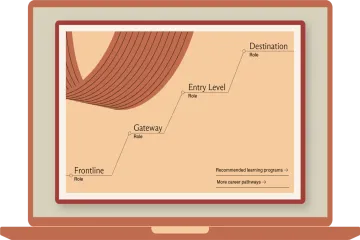
Employees need to see the road ahead. Clear career pathing defines the potential routes an individual can take from their current position to future positions. [9] This isn't a rigid map, but a visualization of possibilities. For instance, a junior marketing associate might see a path leading to content management, social media strategy, or even moving into a product marketing role through specific transitional projects. [9]
When designing these paths, compare the traditional, highly siloed pathing (Role A to Role B) with a more fluid model. The latter acknowledges that lateral moves are part of the path. For example, a highly effective customer service representative might need a six-month stint in process improvement before they are ready to take on a management role that requires deep knowledge of backend operational efficiencies. [5] This intentional slowing down for upskilling prevents premature advancement into roles the individual is unprepared for.
# Matching Technology
Technology should support, not hinder, mobility. Modern platforms can automatically suggest internal openings to employees based on their stated career interests, skill profile, and tenure in their current role. [1][2] When an employee indicates they are ready for a new challenge, the system should actively present relevant options, rather than waiting for the employee to proactively search against a backdrop of dozens of daily emails and tasks. [2]

# Leadership Role
Leadership commitment is non-negotiable for mobility success. [6] If managers are incentivized only for keeping their top performers and actively discourage them from leaving their teams, mobility stalls, regardless of the HR technology in place. [2][4]
# Manager Accountability
Managers must transition from being gatekeepers to being talent developers and enablers. [4] This requires shifting performance metrics. Instead of rewarding managers solely on how long their high performers stay, reward them for how many team members successfully move out to higher-impact roles within the company. [2] This realigns incentives toward organizational success over team hoarding.
Leaders also need to champion mobility in their daily interactions. They must dedicate time during one-on-ones to discuss future roles, not just current task lists. [4] This demonstrates an understanding that the employee's long-term career belongs to the organization as a whole, not just the current department budget line. [6]
# Mentorship Networks
Formalizing mentorship and sponsorship is key. [1] Mentors provide guidance on navigating the organization and developing specific skills, while sponsors actively advocate for an employee when promotion opportunities arise. [4] Effective mobility programs build cross-departmental mentorship pairings specifically designed to expose employees to different business units. An engineer mentoring someone in finance, for instance, builds crucial bridges that inform future cross-functional collaboration.
# Employee Action
While the organization builds the infrastructure, career mobility remains fundamentally employee-driven. [6] Individuals cannot wait for the perfect opportunity to be handed to them. They must take proactive ownership of their development and visibility.
# Self-Assessment
The first step for any employee seeking mobility is brutal self-honesty about their current state. What skills are genuinely transferrable? Where are the largest skill deficits for the next step? Documenting past achievements using quantifiable results, rather than just listing duties, makes one a more compelling internal candidate. [9] A statement like, "Improved system X efficiency by 15%," carries more weight than "Responsible for system X maintenance."
# Networking Internally
Building internal relationships is as important as external networking, perhaps more so in the context of internal movement. [5] Employees should intentionally schedule brief "informational interviews" with people in departments they find interesting. These conversations should focus on understanding the day-to-day challenges of that team and the skills required to succeed there. [5] This builds social capital and creates advocates who will speak positively about the employee when an opening arises, long before the official application process begins.
# Creating Value Projects
If formal internal roles are scarce, an employee can engineer their own developmental move. This involves identifying a problem in another department that aligns with their developing skills and proposing a small, contained project to address it. [1] For example, an HR specialist interested in data analytics could volunteer to build a simple dashboard tracking onboarding time for the Operations team. Successfully completing such a project serves as a concrete, low-risk demonstration of capability, often leading to a permanent transfer or a prioritized development track. [2] This moves the employee from being a passive applicant to an internal consultant, a far more attractive profile to hiring managers.

# Measuring Success
To ensure that these practices actually improve mobility rather than just creating more paperwork, organizations must track the right metrics. [2] Simple metrics like promotion rate are insufficient. Better indicators include:
- Internal Fill Rate: The percentage of open roles filled by current employees. A high rate (often targeted above 50% or 60%) shows the system is working. [2]
- Time-to-Fill (Internal): How quickly internal candidates move into new roles compared to external hiring. Speed signals efficiency. [2]
- Lateral Movement Frequency: Tracking how often employees move laterally. If this number is near zero, it indicates a cultural or structural block against necessary skill diversification. [5]
Reviewing these data points helps leadership diagnose whether the problem lies in skill development (the employee pipeline), system transparency (the job board), or cultural acceptance (managerial gatekeeping). [4] By treating career mobility as a dynamic business process subject to continuous performance review, organizations ensure that professional growth remains central to employee experience and organizational longevity.
Related Questions
#Citations
The 2026 Guide: 10 Ways to Boost Internal Mobility | TalentGuard
Ten Ways to Improve Your Internal Mobility Programs
Transforming Career Stagnation into Career Mobility + 8 Strategies
9 Best Practices for Maximizing Internal Mobility - Heather Nezich
How to Boost Employee Retention by Fostering Career Mobility
Internal Career Mobility: What It Is, Why It Matters, and How to Get ...
Due to no upward mobility in my job, I am losing motivation in my job
Career Mobility: What It Is and How It Can Improve Retention - Namely
The Career Pathing Playbook: Unlock Growth, Retention, and ...