How do you work in platform moderation tech?

The work involved in platform moderation technology is complex, sitting at the intersection of human judgment, rigorous policy enforcement, and advanced automation. It is the essential backbone that allows massive online communities, social networks, and digital marketplaces to function without descending into chaos or violating laws. When you consider how platforms operate, you realize that every piece of content viewed—from a comment to a video—has passed through a filter, whether that filter was an algorithm trained on millions of examples or a dedicated human reviewer operating under strict guidelines.
# Defining Moderation

At its simplest, content moderation is the act of reviewing user-generated material against a platform's established rules or terms of service. These rules govern everything from hate speech and misinformation to copyright infringement and spam. The people performing this work are often called content moderators or online moderators. While some of the earliest forms of moderation relied heavily on volunteer community members policing forums, modern platform moderation technology requires paid professionals handling massive scale and high-stakes decisions.
The scope of this work varies significantly depending on the platform. A social media moderator, for example, might focus specifically on image and text violations across newsfeeds and public posts. In contrast, an online moderator for a large e-commerce site might focus on fraudulent listings or prohibited items. The key is the application of defined standards to dynamic, often ambiguous, user input.
# Human Oversight

Even with sophisticated technology, the final arbiter of nuanced content is often a person. The day-to-day work for a human content moderator typically involves examining content flagged either by automated systems or by user reports. They must quickly assess the violation, verify it against detailed policy documents, and then apply the appropriate sanction, which can range from removing a single comment to issuing a temporary ban on an account.
This work demands a specific set of soft skills that technology struggles to replicate. Moderators need incredible attention to detail to spot subtle violations, sound judgment to interpret context, and resilience to handle disturbing material repeatedly. While some platforms might offer on-the-job training for their specific policy sets, having prior experience in roles requiring high scrutiny or customer conflict resolution can be beneficial. For long-term professionals in this field, the ability to consistently apply complex, often vaguely worded guidelines across thousands of cases daily separates effective moderation from inconsistent enforcement.
The difficulty often lies in context. A statement that is acceptable in a private group discussion might be a violation in a public forum, or slang used innocently in one cultural context could be a slur in another. This is where the human element proves essential; understanding the intent behind a post, rather than just matching keywords, requires cognitive abilities that current artificial intelligence systems still lack. I’ve found that moderators who excel are those who treat policy documents less like rule books and more like legal statutes, requiring deep, contextual interpretation before action is taken.

# Automation Technology

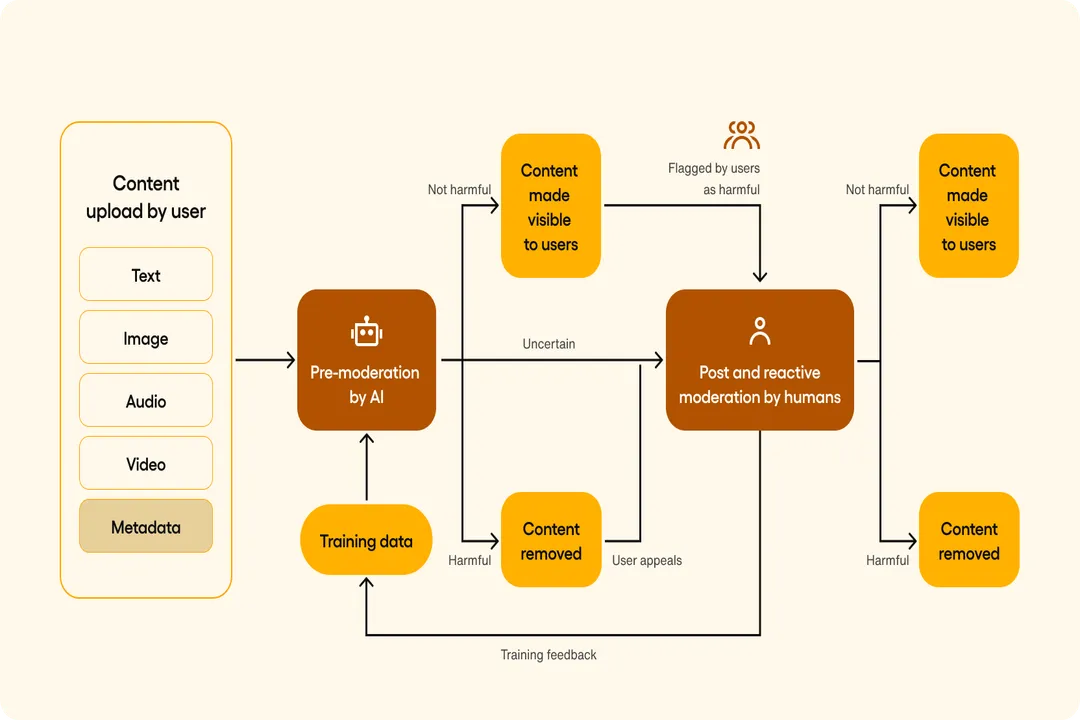
Platform moderation technology fundamentally relies on scale, and humans alone cannot process the billions of pieces of content uploaded daily. This is where automated systems, powered by Machine Learning (ML) and Artificial Intelligence (AI), become indispensable.
Automated moderation works by training models on vast datasets of pre-labeled content—examples of spam, illegal imagery, or abusive language that have already been reviewed by humans. When new content is submitted, the model scores it based on what it has learned.
There are generally two pathways for automated review:
- Instant Removal: Content that scores extremely high on confidence for severe violations (like known terrorist propaganda or child exploitation material) can be removed immediately without human intervention.
- Triage and Flagging: More ambiguous content receives a lower confidence score. The system then pushes this content into a queue for human review, often prioritizing the most likely violations first.
The technology handles the sheer volume, allowing human teams to focus their limited time and energy on the edge cases—the content that requires true understanding of current events, evolving slang, or complex socio-political context.
# Entry Points and Preparation
Getting started in content moderation often involves applying directly to large tech companies or, more commonly, to the third-party business process outsourcing (BPO) firms that platforms contract with for staffing. Requirements generally include being over 18, having a high school diploma or equivalent, and possessing strong typing skills. Fluency in multiple languages is a significant advantage, as global platforms need coverage across different linguistic communities.
If one is looking at the technical side of moderation tech, the path shifts toward data science or AI alignment roles. These individuals are responsible for creating, testing, and refining the models that perform the initial filtering. This requires understanding programming, data labeling protocols, and the ethical implications of algorithmic decision-making.
For those pursuing the human review path, preparing proactively is key. Simply being an active social media user doesn't equate to moderation readiness. A genuinely valuable preparation step involves active policy analysis. I suggest taking the terms of service from a major platform and attempting to write a one-paragraph summary of the rules regarding user impersonation or intellectual property, then comparing your interpretation against official platform guidance. This practice in distilling dense legalistic text into actionable criteria builds the core competency required for the job.

# The AI Moderator Role
The newest development in platform moderation tech is the formalized role of the AI Content Moderator. This is distinct from the traditional human moderator who is reviewing user content; the AI moderator reviews the AI's performance. Their primary function is quality assurance for the models themselves. They audit the decisions made by the automated systems, correcting false positives (content wrongly removed) and false negatives (content wrongly left up).
This specific tech-adjacent role is critical because the algorithms are only as good as the data they are trained on. If the training data contains inherent biases, the model will perpetuate those biases in its moderation decisions. The AI content moderator’s job is to identify and correct these systemic errors, ensuring the platform's policies are being applied fairly by the technology.
# Career Paths and Structure
The career ladder in content moderation usually begins with the high-volume review role. From there, individuals can specialize or move into team leadership. Specialists might focus only on financial fraud, severe mental health disclosures, or nuanced political speech, demanding deeper subject matter expertise. Team leads then manage the human queues, handle escalations that the front-line reviewers could not resolve, and often assist in training new staff on policy updates.
For those interested in building moderation infrastructure rather than working within it, starting a dedicated moderation service is an option. This entrepreneurial route requires understanding client needs, pricing service contracts, and ensuring compliance across various regulatory environments, which is a different skill set than simply executing moderation tasks. This structural difference is important: one path is employment within an existing structure, the other is building the structure itself.

# Reality and Sustainability
It is impossible to discuss working in platform moderation tech without addressing the mental toll. Handling the lowest points of human interaction—exposure to extreme violence, abuse, harassment, and disturbing imagery—is an unavoidable aspect of the work, even when systems are in place to filter the worst material. Platforms use different methods to shield workers, such as blur filters or audio-only reviews for certain content types, but the potential for psychological impact remains high.
For anyone considering this career, understanding the employer's commitment to well-being is paramount. Effective teams prioritize regular, mandated breaks, access to mental health professionals specializing in secondary trauma, and clear escalation paths when a moderator feels overwhelmed by a specific piece of content. Sustained, high-quality moderation work depends entirely on the ability of the platform to protect the long-term mental fitness of its reviewers. This commitment to moderator safety acts as a critical measure of a company’s operational maturity in the space.
#Videos
CONTENT MODERATION JOB - Description, Qualification, What ...
Related Questions
#Citations
How to Become a Content Moderator (Plus Tips) | Indeed.com
CONTENT MODERATION JOB - Description, Qualification, What ...
Online Moderator: What Is It? and How to Become One? - ZipRecruiter
What is a content moderator? Requirements, skills, benefits, & tools
I was a content moderator for many years and have seen everything ...
How to Become a Social Media Moderator
AI Content Moderator: Key Skills, Roles & Responsibilities in 2026
Content Moderator Job Role, Responsibilities & How To Become In ...
How to start up content moderation work - Quora
How automated content moderation works.. - Transcom