Are virtual economy jobs sustainable?

The emergence of widespread virtual employment prompts serious consideration of its longevity. Whether these digitally tethered roles offer a genuinely sustainable structure for global work involves assessing environmental impact, economic access, and alignment with long-term societal shifts, such as the transition to greener systems. [1][8] It is not simply about whether someone can work from a laptop, but whether the supporting digital infrastructure, the necessary skill sets, and the broader economic goals can maintain this model indefinitely. [7]
# Commute Reduction

One of the most immediate and frequently cited sustainability benefits of virtual work relates directly to environmental conservation. By eliminating the daily commute for large segments of the workforce, significant reductions in transportation-related emissions can be realized. [1] This aspect directly addresses a key component of sustainability: minimizing ecological strain. When thousands of employees no longer contribute to rush-hour traffic, the cumulative effect on air quality and fossil fuel consumption is substantial. [1] This environmental relief offers a compelling case for the sustainability of remote setups, provided the energy consumption of data centers supporting this work is managed responsibly.
# Worker Empowerment
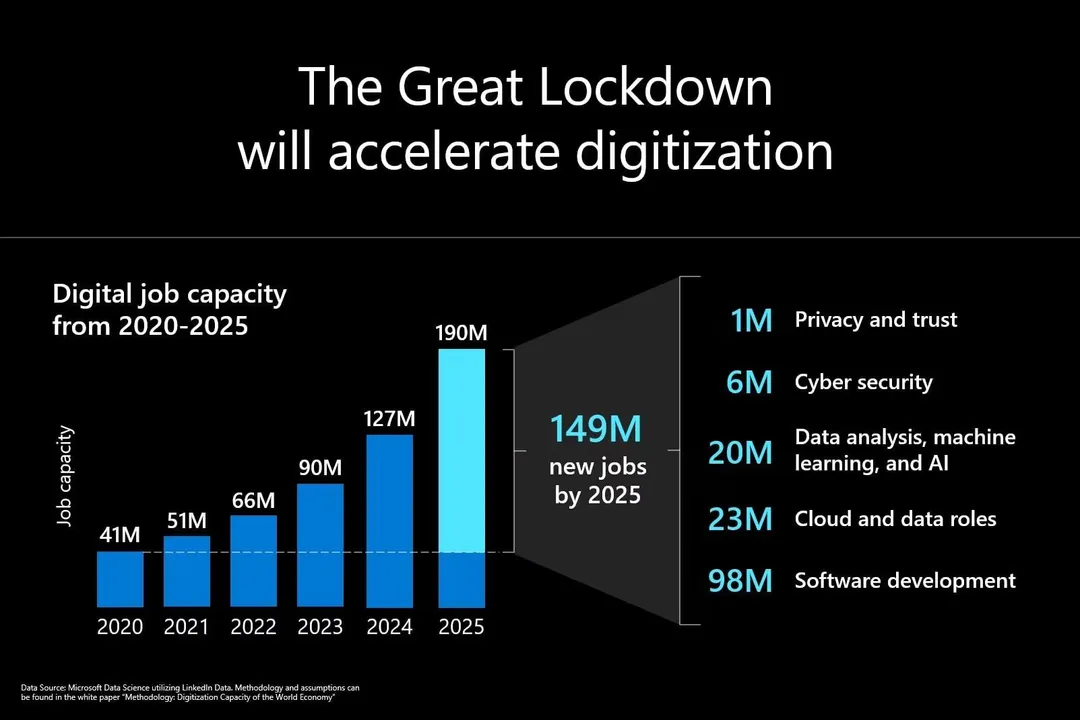
Beyond environmental factors, the sustainability of virtual jobs is significantly bolstered by their transformative social impact, particularly in emerging markets. [3] Remote and online employment models grant access to work opportunities that were geographically inaccessible just a decade ago. [3] For individuals in these regions, this access translates into greater economic participation, increased income potential, and a reduction in brain drain, as skilled workers are no longer forced to relocate to global hubs to find relevant employment. [3] This democratization of access ensures a broader, more inclusive base for the digital economy, suggesting resilience rooted in social equity.
A comparative look shows that while traditional employment often anchors opportunity to expensive, high-density urban centers, virtual roles decouple income from high cost-of-living areas. [3] For instance, a worker in a developing nation can contribute to a tech project based in a Western city without relocating, stabilizing local economies through the inflow of international wages. This social sustainability—the ability to create equitable global opportunities—is a powerful driver for the continued viability of virtual work.

# Digital Upskilling
The continuing need for digital proficiency underpins the entire virtual job market. As more processes migrate online, the imperative for workers to acquire digital skills becomes paramount, linking directly to sustainability goals. [2] The transition towards a green and digital economy across regions like Europe emphasizes that future employment success hinges on adapting to these new demands. [8] This transition isn't just about having a computer; it requires specialized training in areas that facilitate this dual shift. [2]
The skills required are evolving rapidly. It is no longer sufficient for a remote worker to simply process data; they must often understand how to apply digital tools to solve complex problems related to resource management or operational efficiency. [8] In many professional contexts, the discussion around work's future is inseparable from discussions about how digital upskilling supports sustainability initiatives. [2] Those who adapt their expertise to fit this new demand are likely to secure the most durable positions.
# Structural Viability
When assessing the long-term staying power of remote employment, one must look past individual jobs toward the underlying economic mechanics. The general viability of an economy continuing to function effectively with a highly distributed workforce has been a topic of general discussion, suggesting that the foundational systems for transactions, communication, and output measurement seem capable of supporting widespread remote activity. [4] However, sustainability in this context also requires stability in management and corporate structure. [7] The question isn't if the work can be done remotely, but whether organizations can effectively manage culture, innovation, and productivity over extended periods without the established norms of in-person interaction. [7]
A critical component for long-term success is moving beyond simple task execution to building sustainable organizational relationships within a virtual setting. If a company relies solely on short-term, task-based gig contracts mediated by platforms, the social security and career path sustainability for the worker are questionable, even if the company saves on overhead. A more sustainable model integrates these remote workers into the core structure, offering benefits and pathways for advancement, much like traditional employment structures. [9]
Consider the difference between a fully distributed company (where all roles are designed to be remote) versus a hybrid mandate (where remote work is a contingency measure). The former, which builds its processes, security protocols, and culture around digital interaction from the ground up, is inherently more stable than the latter, which often struggles with equitable treatment between in-office and remote staff. [7]
Here is a subtle point regarding stability: While the environmental argument centers on reduced physical travel, the economic sustainability of virtual work relies heavily on digital infrastructure parity. A job is only as sustainable as the local internet access and reliable power grid supporting it. Therefore, true sustainability demands investment not just in worker software skills, but in the physical infrastructure connecting the remote employee to the global network. [3] If a region cannot guarantee consistent, high-speed connectivity, those virtual jobs are precarious, regardless of their digital nature.

# Green Digital Intersection
The convergence of digital work with tangible environmental goals presents the strongest argument for enduring sustainability. Many view the future professions as those that effectively marry the virtual capacity with green imperatives. [5] This suggests that the most sustainable virtual jobs will be those directly involved in furthering environmental objectives, such as roles utilizing Artificial Intelligence (AI) for climate modeling or supply chain optimization that reduces waste. [6]
For example, an analyst working remotely to model the carbon capture potential of different soil types is performing a virtual job that directly contributes to planetary sustainability goals. [6] This synergy creates a positive feedback loop: the digital economy provides the tools, and the need for environmental solutions provides the demand for those digital tools. The intersection where digital transformation supports sustainability initiatives is where the most value, and thus the most enduring employment, will likely be found. [6]
To further this alignment, an actionable path for individuals entering this sector involves intentionally seeking out domains where digital skills are applied to material resource challenges. Instead of focusing solely on digital marketing or pure software development, workers can pivot toward areas like remote energy grid monitoring, virtual auditing for environmental compliance, or developing platforms for sharing sustainable resources. This specialization moves the job description from merely "virtual" to "essential for the green transition". [5]
The evolution of professional roles from early virtual reality applications towards comprehensive sustainability goals demonstrates a clear trajectory for where the market values digital contribution most highly. [5] When the digital economy is tasked with solving the planet's most pressing resource and climate issues, its relevance—and the sustainability of its jobs—is significantly increased. [9]
# Governance and Longevity
Ultimately, the sustainability of any economic sector, virtual or otherwise, rests on sound governance and long-term planning. [9] For virtual jobs to remain viable, the legal, tax, and labor frameworks governing them must mature to protect both the worker and the employing entity. [7] This includes establishing clear standards for data security and intellectual property protection when work crosses multiple jurisdictions without a central office. [9]
The current environment, which was often shaped by immediate necessity (like the pandemic response), is evolving into a more structured future. [7] For this transition to be sustainable, regulatory bodies and corporate leadership must agree on what constitutes fair employment practices for remote, cross-border digital labor. [9] Without this established authority and trust—the 'T' in E-E-A-T, applied broadly to the economic system—the virtual economy risks becoming a temporary stop-gap rather than a permanent fixture of the employment landscape. [7] If the system can successfully adapt its governance structures to account for geographic dispersion and asynchronous work, the foundation for sustained growth is laid.
Related Questions
#Citations
Remote To The Rescue: How Virtual Jobs Are Saving The World
Why digital upskilling is a crucial part of sustainability
How Online Jobs are Empowering Workers in Emerging Markets
How is our economy going to remain sustainable with many jobs at ...
From Virtual Reality to Sustainability: The Professions of the Future
The death of tech jobs? 1-hour innovation process to a green economy
Is the global work from home experience sustainable? - Quora
Changing job trends: how transition towards a green, digital ...
Can the Digital Economy Promote Sustainable Improvement ... - MDPI