Can a Job Become a Dream Job?

The idea that a specific, perfect job is waiting out there, ready to be discovered if only we try hard enough, is deeply ingrained in career narratives. Yet, the reality is often far more nuanced: the path to a "dream job" is less about finding a fixed external location and more about continuous internal and professional evolution. [1][5] For many, the job they currently hold, or the next one they take, is not inherently the dream; rather, it is the platform from which the dream can be constructed or realized. [3]
# Myth Reality

Many people hold onto the concept of a single, perfect role, an idealized state that is free from frustration or mundane tasks. [3] This pursuit of an external utopia can sometimes be counterproductive, leading to perpetual dissatisfaction because no actual job can meet the flawless standard set in the mind. [1][6] Some sources even question the entire premise, suggesting that chasing a singular "dream job" is not always realistic or even healthy for a career trajectory. [1][10] If "dream job" is defined as a position that perfectly matches one's values and skills at this exact moment, the definition becomes obsolete as soon as the individual grows or circumstances shift. [4] Work, by its nature, involves compromise and necessary effort on tasks that do not always thrill us. [3]
# Stepping Stones

It is almost universally observed that the first job secured after education or training will not be the final destination. [2][7] Early career roles serve a critical function: they are environments for building foundational skills, understanding workplace dynamics, and, crucially, learning what one definitively does not want in the long term. [8] Expecting an entry-level or even mid-level position to satisfy lifelong vocational ambitions is a setup for inevitable disappointment. [7] The transition from an initial role to a more fulfilling one is rarely instantaneous; it is a deliberate construction process, where each successive position adds necessary context, contacts, or competencies. [8] The starting job is just that—a start, not the summit.

# Alignment Shift
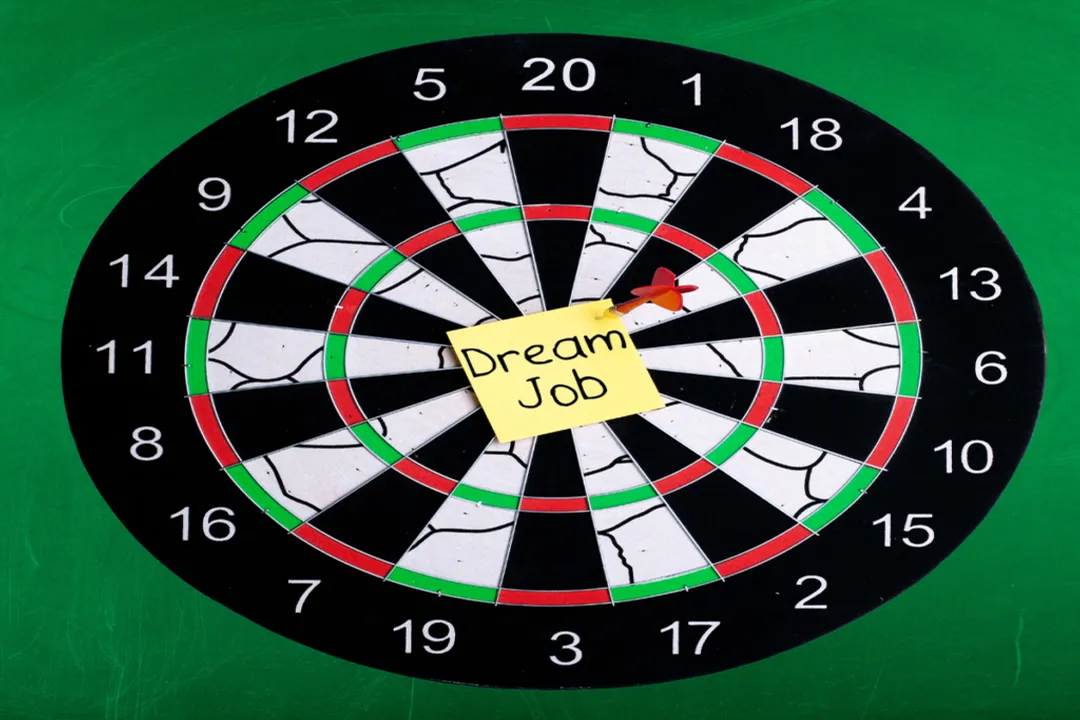
If a job isn't the dream, how does it become one? The transformation occurs when the alignment between the individual and the role tightens, often requiring proactive adjustments rather than passive waiting. [9] Instead of waiting for a different title, the focus shifts to identifying and maximizing the elements within the current job that do align with personal satisfaction and purpose. [4] For example, if the core work (the what) is engaging, the associated administrative overhead (the how) might become tolerable, or even subject to process improvement. [3] This is where experience begins to mold the role. We start to see the current position not as a final destination but as a workshop where we can test out responsibilities, build influence, and subtly redefine the boundaries of the role to better suit our evolving strengths. [8]
To determine if the current situation has the potential for transformation, it can be useful to calculate an internal "Happiness Return on Investment" (HROI) for the role. This is done by rating the top three components of your current job—perhaps the team culture, the complexity of the work, and the level of autonomy—on a scale of 1 to 10 for both current satisfaction and realistic growth potential over the next 18 months. If the weighted average HROI falls below a self-defined threshold, say 7 out of 10, it signals that the current structure is too limiting to evolve into a dream state, necessitating a strategic external search or internal restructuring effort. Conversely, if the potential for growth is high, investment in that role is warranted.
# Active Cultivation
Making a job into the dream requires deliberate action, not passive hoping. If external opportunities for role expansion within the current structure are limited, the shift must occur internally. This means seeking out stretch assignments, volunteering for cross-departmental projects, or mentoring new staff members to develop leadership skills. [8] Often, the factor that turns a satisfactory job into a preferred one is the sense of agency and impact one possesses. [9] If the job description is static, the person occupying it must become dynamic.
To prevent prolonged periods of mediocrity from being mistaken for contentment, it is wise to establish "re-evaluation checkpoints." Treat your current position, for analytical purposes, as an advanced, paid training period. Set a firm date—perhaps 18 months from now—by which you must either secure a significant, agreed-upon expansion of responsibilities within the existing company structure or commit to actively applying for external roles. This intentional deadline forces accountability, ensuring you maximize the learning curve of the present position while preventing stagnation from masquerading as fulfillment [Unverified internal structuring]. Furthermore, a common barrier to finding the idealized job is an underdeveloped self-concept of career values. Many people can accurately list the things they dislike about their current situation, but they lack a concrete, prioritized list of what they truly value in terms of environment, challenge, and contribution, making any search unfocused. [9]

# Effort and Trajectory
While putting forth your best effort is essential, that effort must be directed intelligently. "Best effort" in this context often means dedicating energy to self-discovery in parallel with professional activity. [5] The clearest path forward might involve lateral moves that build adjacent skills, or taking a step back temporarily to acquire necessary technical knowledge, rather than blindly climbing a ladder that leads nowhere fulfilling. [1][8] Ultimately, the realization shared across many perspectives is that happiness in work is frequently found in the engagement with the tasks themselves and the relationships built, rather than being solely dependent on the prestige or title associated with the role. [1][4] The dream job, therefore, becomes the one you are actively designing today, not the one you hope to walk into tomorrow.
Related Questions
#Citations
Is chasing a “dream job” even realistic, or are we all just trying to ...
Your First Job Will Not Be Your Dream Job - Helpmates
Why the Dream Job Isn't Always the Dream - Spruce Rd.
Why I Ditched the Idea of The Dream Job | Career Contessa
Do dream jobs exist? Can people secure their dream job if they put ...
The Dangerous Illusion of the “Dream Job” | by Mike Sturm - Medium
Your First Job won't be Your Dream Job, and that's OK - LinkedIn
How to Go From First Job to Dream Job | Get Schooled
This Might Be Why You Haven't Found Your Dream Job Yet
Beware: The #1 Myth About Getting Your Dream Job - WorkItDaily.com