How do you start a career in quantum networking?
Building a career in quantum networking sits at a fascinating intersection of cutting-edge physics and essential global infrastructure demands, particularly around securing information. This emerging field is not a distant vision; quantum networks are actively being built today by entities like governments, utilities, and financial institutions that require protection for highly sensitive data-in-transit. The shift from traditional data handling to quantum-secure communication is driven by the looming threat of cryptographically relevant quantum computers, often referred to as Q-Day, which Gartner estimates could arrive as early as 2029.
The core difference between current and future networks lies in the fundamental unit of information. Classical networks move bits (0 or 1), which can be copied and amplified by routers to extend distance. Quantum networks, however, rely on qubits, which exist in superposition and are governed by the no-cloning theorem—meaning they cannot be copied without disturbing their state. This physical property underpins the ultimate security of Quantum Secure Communications (QSC), which derives its guarantee from physics, not computational difficulty.
# Network Roles
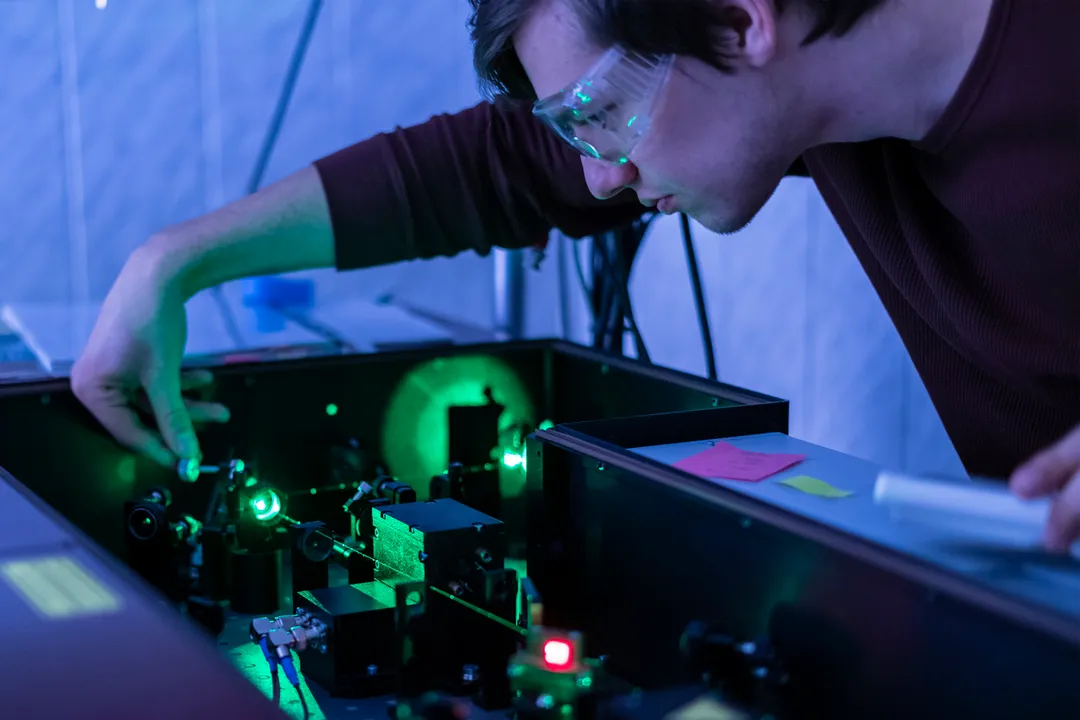
Quantum Networking Engineers operate at the vanguard, blending theoretical physics, practical engineering, and advanced technology to build this infrastructure. The roles emerging are varied and crucial for making long-distance, secure quantum links feasible.
Key responsibilities and focus areas include:
- Quantum Key Distribution (QKD) Development: Designing and implementing protocols that allow two parties to securely share encryption keys, relying on the fact that any eavesdropping attempt immediately alters the quantum state, thus flagging the breach.
- Quantum Repeaters: Addressing the significant hurdle of signal loss over distance. These specialized systems extend the range of quantum communication networks in ways classical repeaters cannot, as they must preserve entanglement without measuring the qubits themselves.
- Entanglement Distribution: Focusing on the maintenance and distribution of quantum entanglement across network links, which is foundational for both secure communication and advanced applications like quantum teleportation.
- Error Correction: Developing methods to counteract quantum errors induced by environmental noise, which is necessary to ensure the reliability required for real-world application.
- Satellite Systems: Working on space-based infrastructure to enable truly global quantum communication channels across vast distances.
Beyond direct communication security, quantum networks also aim to interconnect quantum processing units to scale computing power, and connect quantum sensors for enhanced precision in areas like position, navigation, and timing (PNT).
# Technical Stack
A quantum network is far more than just a new type of wire; it requires a structured protocol implementation across several layers, much like the classical internet stack. Understanding this structure is key for anyone entering the engineering or development side of the field.
The quantum network stack is generally described in five layers:
- Physical Layer: This layer encompasses the actual hardware components: memories, detectors, photon sources, and the interconnects.
- Link Layer: Deals with the protocols required to generate entanglement across a single link.
- Network Layer: Focuses on distributing that established entanglement across multiple nodes in the network.
- Transport Layer: Protocols responsible for the actual transmission of qubits over the established, entangled links.
- Application Layer: This is where the specific use cases reside, such as implementing Quantum Secure Communications (QSC).
To manage this complexity, several core software elements are necessary across the network nodes. These include a physics-accurate quantum network simulator for testing designs before hardware procurement, an SDN-style orchestrator to manage hardware and route entanglement requests, and a real-time operating system (OS) acting as the low-level control brain for the hardware. These software components allow an operator to manage services, track network health metrics like QBER (Quantum Bit Error Rate), and coordinate hardware across the network.

# Education Pathways
The path into quantum networking is multidisciplinary, but it generally leans toward advanced academic achievement or specialized professional transition. While a PhD in Physics, Electrical Engineering, or Computer Science is often preferred for research-heavy roles, a Master's degree coupled with relevant experience can be sufficient for many positions.
For individuals with foundational degrees in STEM fields like math, physics, computer science, or electrical engineering, targeted education is the next step. For example, some intensive eight-week online courses prepare participants by simulating multi-node quantum networks and covering key concepts like superdense coding, QKD, and quantum repeaters.
Prerequisites for such programs, and by extension, for entering the field, are quite specific, centering on mathematical formalism and practical programming skills. A strong foundation in linear algebra (matrix operations, eigenvectors, SVD) and probability theory (conditional probabilities) is essential, as is proficiency in Python for using tools like Qiskit. If you are coming from an engineering background, you might focus on courses that bridge into physics, while those from a pure math or CS background must deliberately seek out quantum mechanics fundamentals.
One of the most valuable insights from those already in the industry is that a quantum-specific background is not always mandatory, particularly for engineering roles; a large percentage of staff at one quantum computing company joined with no prior quantum qualification. This suggests that if you possess strong, transferable skills in an adjacent field, you can build upon that foundation.
# Core Competencies
While specific roles dictate the focus, a shared set of technical and mathematical competencies defines the quantum networking professional.
# Mathematical Rigor
The foundation for understanding quantum information is mathematics. Deep competency in linear algebra is repeatedly cited as the single most useful preparation. This is necessary to apply the mathematical formalism of qubits, state vector evolution, and performing essential calculations like expectation values. Beyond linear algebra, a strong grasp of probability theory is key. For theoretical development, more advanced mathematics like functional analysis or topology might be required, but for applied engineering and protocol work, mastering the basics is the starting point.
# Programming Skills
Programming is indispensable for simulation, testing, and development within the field. Proficiency in languages like Python is paramount, often specifically involving quantum SDKs such as Qiskit or Cirq. Experience with quantum network simulators that model the underlying physics (like fiber loss) is also highly sought after.
# Physics Knowledge
A deep understanding of core quantum mechanics concepts—specifically superposition, entanglement, and decoherence—is non-negotiable, as these principles define the network’s capability and limitations. Furthermore, knowledge of the physical means of transmission, such as optical fibers and photonics, is vital for engineers working on the physical layer.
As you specialize, remember that the conceptual leap from classical to quantum networking is significant. For those transitioning from classical telecommunications, while familiarity with optical fibers is a great start, the true challenge is shifting the mindset from signal amplification to entanglement distribution and teleportation as the means of extending reach. This conceptual pivot is where many new entrants must focus their learning efforts.

# Gaining Ground
Breaking into this young, high-demand industry requires a strategic combination of formal learning, practical application, and professional visibility.
# Experience First
Formal education can open the door, but demonstrated experience secures the role. Actively seek out internships at established tech giants, specialized quantum firms, or national research institutions. Engaging in academic research projects is another critical pathway, allowing you to contribute to scientific journals and build a portfolio of credibility. If formal research isn't immediately accessible, look for opportunities to work with specific quantum development tools. For instance, familiarizing yourself with software like SeQUeNCe for protocol implementation alongside Qiskit for circuit design will prove you can connect theory to practice.
# Networking Visibility
The quantum community is relatively small and highly collaborative. Attending industry conferences, workshops, and webinars is essential for staying current and connecting with leaders. Beyond in-person events, cultivating a professional online presence, particularly on platforms like LinkedIn, helps connect you with relevant groups and professionals in the field.
If you are applying for a role where you lack a direct quantum background, a strong cover letter becomes crucial. Instead of just listing qualifications, clearly articulate why you want to work for that specific company and provide concrete examples of how your existing skills (e.g., in classical engineering, signal processing, or complex mathematics) align with the role's requirements. Showing genuine passion and a willingness to learn the quantum specifics through self-study resources can compensate for missing formal qualifications.
# Software Focus Tip
For those primarily targeting the software, protocol, or simulation aspects of quantum networking, focus your self-study to mirror the practical needs of deployment. While general quantum mechanics is important, directly attacking the prerequisites for hands-on work—namely Linear Algebra and Python/Qiskit—will accelerate your path to contributing code. Specifically, spend dedicated time understanding how to debug quantum circuits, as this involves applying your linear algebra knowledge to interpret simulation outputs where decoherence and noise introduce errors. This targeted mathematical focus ensures your coding proficiency is built on a solid theoretical foundation, making you more valuable than someone who only knows the high-level syntax of a framework.
# Industry Outlook
The commercial landscape for quantum networking is expanding rapidly, attracting significant investment from both governments and major corporations. Industries such as financial services, telecommunications, defense, and healthcare are actively seeking professionals to secure their future networks. This broad industrial pull means opportunities span hardware fabrication, systems engineering, protocol design, and high-level orchestration software. The field's current nature allows for significant impact, as professionals are not just maintaining old systems but designing the necessary architecture from the ground up. For those passionate about cryptography, secure communications, and distributed systems, the convergence of these disciplines in quantum networking promises a career that is both intellectually demanding and economically rewarding.
#Videos
How to be a Quantum Engineer (just copy me step by step) - YouTube
Related Questions
#Citations
Quantum Networking Jobs: Career Path, Skills, and Opportunities in ...
What to study to work in Quantum Computing? - Reddit
Quantum Science, Networking, and Communications
How to be a Quantum Engineer (just copy me step by step) - YouTube
Quantum Networking 101 - Aliro Technologies
How would I start a career as a Quantum Information Scientist?
Thinking of a career in quantum computing? - Riverlane