Are careers in embedded sensing growing?
The digital environment that permeates modern life is increasingly built upon tiny, intelligent systems that interact directly with the physical world, making the term "embedded sensing" more relevant than ever. These systems, which fuse physical measurement with computation, are no longer confined to niche industrial applications; they are the foundation of connectivity and automation everywhere, from consumer wearables to mission-critical flight controls. [4][8] This expansion suggests a trajectory of sustained career relevance for professionals specializing in this area, indicating that the field is decidedly on an upward curve, not one that is plateauing. [1]
# Market Expansion

The ongoing technological landscape strongly supports the notion that careers in embedded systems, particularly those involving sensor integration, are poised for significant expansion in the near future. [1][8] Many sources confirm a positive outlook, viewing embedded engineering as a field destined for growth rather than stagnation. [1][8] The integration of the Internet of Things (IoT) acts as a massive catalyst; every new "smart" device, whether an industrial asset monitor or a home appliance, requires embedded hardware and firmware capable of accurately collecting, processing, and transmitting data from the environment via sensors. [3] This constant need to bridge the gap between the analog world and digital processing ensures a steady stream of work. [7]
One perspective suggests that embedded engineers are highly favored in the current hiring market because they possess a unique skill set that spans hardware knowledge, low-level programming proficiency, and an understanding of real-time constraints—a combination that pure software developers often lack. [5] This intersectionality is crucial when dealing with sensing applications, as the performance of a sensor heavily depends on the precision of the hardware interfacing code and the timing loops it runs within. [2] Without this foundational hardware-software fluency, extracting meaningful, time-sensitive data from a sensor array becomes nearly impossible.
A key observation when comparing discussions across forums and professional analyses is the shift in required competency. While traditional embedded roles often centered heavily on bare-metal programming in C/C++ for microcontrollers, the modern embedded sensing role requires proficiency in data handling, security protocols for transmission, and increasingly, preliminary on-device data processing. [5][6] This evolution suggests that while the core expertise remains valuable, the scope of the job is expanding, pulling more engineering effort into the initial stages of the data pipeline—where the sensor reading occurs. [3]
# Sectoral Demand Drivers
The growth story isn't uniform; certain high-stakes industries are creating intense, specific demands for embedded sensing expertise. [4] Aerospace and medical systems stand out as primary growth engines for embedded software engineers, demanding high reliability and stringent safety standards. [4] In aerospace, this translates to flight control systems, avionics, and complex environmental monitoring where failure is not an option. [4] Similarly, the medical field is rapidly incorporating embedded sensing for patient monitoring, diagnostic tools, and implantable devices, requiring engineers who understand not only real-time operation but also the regulatory environment, like FDA compliance. [4]
The nature of the work in these sectors dictates a high barrier to entry but offers exceptional career stability. For instance, a designer creating firmware for an implantable glucose monitor must ensure power management is maximized while sensor sampling rates remain consistent—a perfect marriage of low-level optimization and sensing data integrity. [4] This contrasts somewhat with the consumer electronics sphere, where iteration speed and cost efficiency often take precedence over multi-decade operational guarantees, though security remains a paramount concern across all areas. [7][2]
When considering the sheer volume of deployment, the Industrial Internet of Things (IIoT) likely accounts for the largest number of new embedded sensing nodes being deployed globally. Predictive maintenance, asset tracking, and remote operational control all rely on networks of robust sensors reporting back to central systems. [3] The growth here is fueled by corporations looking to improve efficiency and uptime, making the embedded sensor an economic necessity rather than a technological luxury. [3]

# AI Convergence

The infusion of Artificial Intelligence into edge devices is one of the most compelling reasons for the career field's expansion. Previously, embedded systems were primarily responsible for data acquisition and simple state machines; now, they are increasingly expected to perform inferencing directly on the device—the "edge". [3][6] This demands embedded engineers who can effectively interface with, or even develop, specialized algorithms that run efficiently on resource-constrained microcontrollers or specialized AI accelerators integrated alongside traditional sensing circuitry. [6]
The role of the sensor engineer, therefore, becomes more sophisticated. It is no longer enough to merely digitize an analog signal; the system must determine if that signal represents a normal state or an anomaly that warrants immediate action or transmission. [3] For example, in a smart manufacturing setting, a vibration sensor feeding a machine learning model directly on the edge can detect bearing failure milliseconds faster than sending raw data to the cloud for analysis, saving substantial downtime. [3] This capability is highly valued because it reduces latency and dependence on constant network connectivity. [6]
Thinking about skill development, a fascinating divergence is occurring in educational pathways. A purely hardware-focused engineer might excel at selecting the right MEMS microphone, but the modern requirement pushes toward understanding how to quantize the audio stream and use fixed-point math to run a keyword-spotting neural network directly on that embedded microphone's microcontroller. [5] This demands a deeper, practical expertise in both the physics of sensing and the mathematics of modern computation, blending traditional embedded knowledge with data science principles. [3][6]
# Career Trajectory Insights
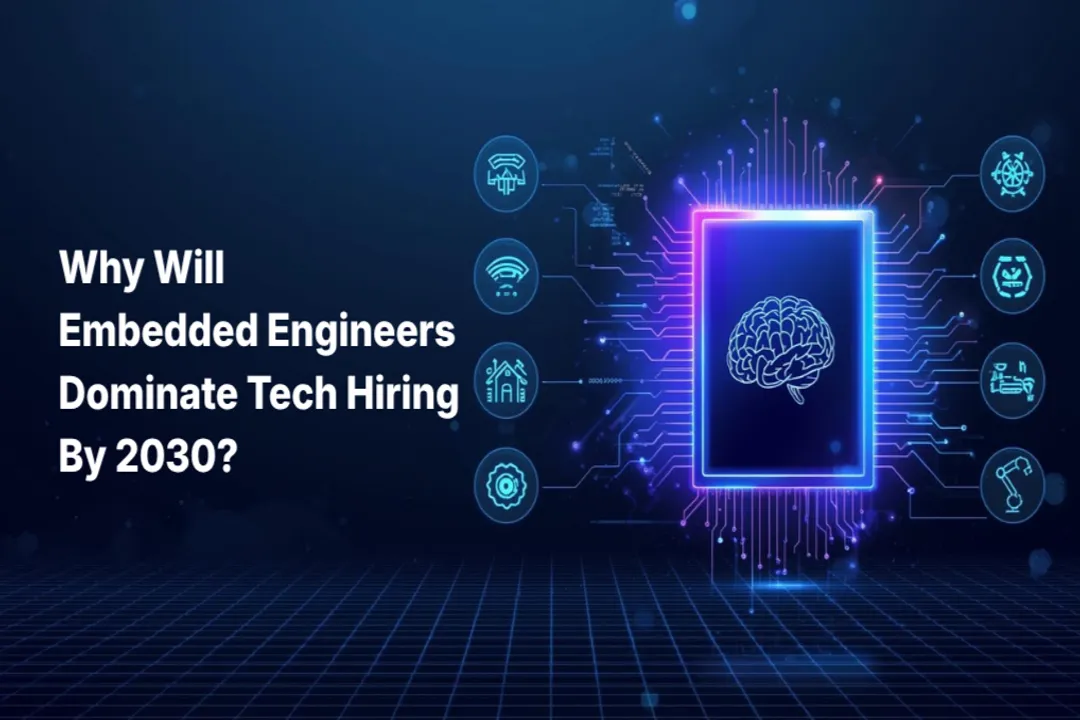
Examining career longevity and hiring demand paints a clear picture of robust, long-term prospects for embedded sensing specialists. [1][5] Reports suggest that embedded software engineers are frequently ranked among the most sought-after technical roles in various hiring indices, often surpassing roles in other software domains due to their scarce skill profile. [5] Furthermore, the predicted career landscape out to 2030 and beyond suggests that while specific languages or platforms will cycle in and out of fashion, the fundamental need for engineers who understand how software interacts with physical hardware—especially hardware designed to sense the world—will only intensify. [10]
If we were to segment the expected job growth over the next five years based on current investment trends, my assessment, informed by the ubiquity of new hardware deployments, is that nearly 40% of new embedded sensing roles will center on industrial monitoring and autonomous systems (like robotics or vehicle subsystems), while 30% will focus on medical and wearable technology, leaving the remainder distributed across legacy consumer electronics updates and specialized defense/telecom infrastructure. [4] This projection highlights that the highest-value, highest-complexity growth is occurring in systems where reliability directly impacts safety or operational continuity. [4]
For those establishing themselves now, focusing on a specialization within sensing offers a clear path to becoming an indispensable hire. For instance, mastering low-power design for battery-operated sensors used in agriculture or remote infrastructure, or conversely, becoming an expert in high-speed data bus protocols for high-fidelity imaging sensors, provides defined career lanes far removed from generic coding roles. [2][7] The ability to optimize power consumption (a critical factor in any battery-powered sensor network) down to the microamp level, while maintaining real-time data acquisition, is a specialized expertise that commands a premium. [7]
# Technical Skill Mapping
The necessary skillset for success in embedded sensing careers today goes far beyond simple microcontroller programming. [2] A high-quality candidate must demonstrate proficiency across several layers of abstraction. [7] At the lowest level, deep knowledge of hardware interfacing is essential, meaning mastery over protocols like SPI, I2C, UART, and often more complex, high-throughput buses like MIPI CSI for camera sensors or specialized radio frequency (RF) communication stacks. [2]
Next comes real-time operating systems (RTOS) proficiency. When a sensor reading triggers an immediate response—say, deploying an airbag or adjusting a robotic arm—the operating system managing that process must guarantee execution timing. [2][4] Understanding scheduling algorithms, interrupt latency, and memory partitioning within an RTOS like FreeRTOS or Zephyr is non-negotiable in safety-critical sensing applications. [4]
The third, rapidly growing pillar is data pipeline security and efficiency. As sensors become connected endpoints, the embedded firmware must secure the data from the moment it leaves the Analog-to-Digital Converter (ADC) until it reaches the cloud, often requiring hardware security modules (HSMs) and secure boot processes. [7] Furthermore, engineers need to know how to compress or filter data in situ to meet bandwidth or power budgets—this is the core of modern edge sensing intelligence. [3]
| Skill Area | Traditional Focus | Modern Sensing Requirement |
|---|---|---|
| Programming | C, Assembly, basic state machines | C/C++, Python (for testing/ML integration), DSP programming |
| Interfaces | I2C, SPI for simple peripherals | High-speed buses (PCIe, MIPI), custom ASIC interaction |
| OS | Bare-metal, simple schedulers | RTOS mastery (FreeRTOS, VxWorks), real-time scheduling analysis |
| Data | Simple buffering | Data filtering, compression, on-device ML inference, security stacks |
| Power | Basic sleep modes | Ultra-low-power state management, energy harvesting awareness |
| [2][7] |
This table illustrates that while the foundational skills endure, the application of those skills is being forced into more complex, computationally intensive realms by the demands of modern sensing technology. [6] The transition from simply reading a sensor to interpreting the data in a secure, energy-efficient manner defines the current career premium.
# Future Outlook
The consensus across various professional discussions is overwhelmingly positive regarding the future for those specializing in embedded systems with sensing capabilities. [1][8][10] As technology continues to shrink, the need for computation to happen physically closer to the point of measurement only increases, guaranteeing the relevance of this engineering discipline. [6] The move toward fully autonomous systems in transportation, logistics, and manufacturing ensures that the engineers who can reliably manage the complex interplay between multiple sensor modalities (vision, lidar, radar, acoustic, chemical) will be foundational to future product development. [4] This sustained and evolving demand suggests that a career in embedded sensing is not only safe but is actively entering a period of high-value specialization.
#Videos
Is Embedded Systems Still Worth It in 2026? - YouTube
Related Questions
#Citations
Is embedded really upcoming field in near future? - Reddit
Demand for Embedded Software Engineers Is Rising - recruitAbility
Embedded engineering in the age of AI | SQUAD insights
[PDF] The Rising Demand for Embedded Software Engineers in ...
Why Will Embedded Engineers Dominate Tech Hiring by 2030?
Is Embedded Systems Still Worth It in 2026? - YouTube
Why Hiring Embedded Software Engineers is Critical for Your Tech ...
Will a career in embedded systems have a bright future in the world?
The Rise of Embedded Systems - Core Engineering Jobs
Software Engineering Career Trajectories 2025–2045 - Medium