How Much Do Logistics Professionals Earn?

This is a complex field where earning potential shows remarkable variation, heavily dependent on the specific role, experience level, and geographic market. The broad umbrella of "logistics professionals" covers everything from entry-level coordinators to specialized analysts and executive directors managing global distribution networks. Understanding where one fits within that spectrum is key to assessing compensation. [5]
For the general function of "Logistics" across the United States, one data aggregator reports an average annual pay of about \76,301**, with the typical range sitting between the 25th percentile salary of **\56,500 and the 75th percentile of \34,000 spread. [3] On the high end, top earners (90th percentile) can see annual salaries reaching \116,500** or more, while the lowest reported figures start around **\34,500. [3] Another source, referencing skill-based compensation, suggests the average base salary for the skill "Logistics" overall is closer to $68,000 per year. [1]
# Role Pay Grades
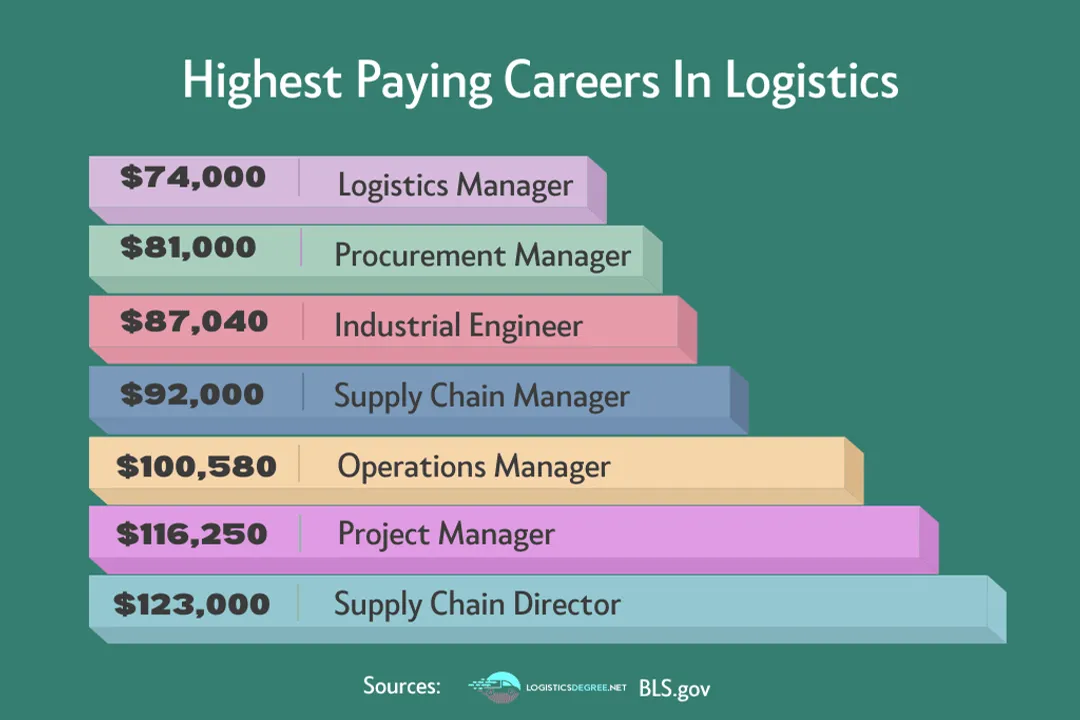
The title held by a professional often dictates the compensation floor and ceiling. Roles focused on coordination or support tend to be on the lower end of the salary spectrum compared to those managing large systems or strategic outcomes.
When comparing specific job titles, distinct pay tiers emerge based on responsibility:
| Job Title | Average Annual Salary (Approximate) | Reference Range Source |
|---|---|---|
| Logistics Manager | \77,119 (Range: \54k – $109k) | Payscale [1] |
| Logistics Manager (Projected) | $75,000 – $100,000 (Base) | Techneeds [6] |
| Logistics Coordinator | \54,497 (Range: \41k – $77k) | Payscale [1] |
| Logistics Specialist | \61,578 (Range: \41k – $84k) | Payscale [1] |
| Logistics Analyst | \69,569 (Range: \54k – $96k) | Payscale [1] |
| Supply Chain Manager | \89,692 (Range: \60k – $124k) | Payscale [1] |
For those holding the title Logistician specifically, the U.S. Bureau of Labor Statistics (BLS) reported a median annual wage of \49,260, while the top 10% earned more than $132,110. [4]
The difference between a Coordinator and a Manager is quite evident. A Logistics Coordinator might see their salary range start in the low \40,000s** [^1], whereas a Logistics Manager’s average is often nearly **\23,000 higher. [1] Furthermore, a Logistics Specialist sees a median salary around \60,845** according to one source, though another source places the *median total pay* for specialists at **\80,000. [5] This highlights the critical distinction between base pay and total compensation which often includes bonuses or profit-sharing. [5]
# Industry Influence
It is frequently mentioned across professional discussions that an individual’s compensation is inextricably linked to the industry they serve. [2] Moving from a third-party logistics provider (3PL) to an in-house role, such as working for a wholesale company instead of a 3PL, resulted in one professional gaining an additional $25,000 plus a bonus. [2]
The BLS shows that for official Logisticians, the industry paying the highest median wage is the Federal government at \101,110** [^4]. This contrasts with roles in Wholesale Trade, which paid a lower median of **\73,090. [4] For Logistics Specialists specifically, working in Government and public administration leads the pack with a median total pay of \75,223**, followed closely by **Pharmaceutical and biotechnology** at **\73,176. [5] Industries dealing with high-value or heavily regulated products—like Aerospace & Defense—also feature higher compensation potential. [5]

# Experience and Growth
Salary progression in logistics is generally robust, provided the professional adapts and moves strategically. An early career professional in Canada might start at \37,500** as a supervisor, potentially reaching **\82,000 nine years later, requiring company changes to achieve those significant jumps. [2] Another professional noted moving from a coordinator role earning \42,000** to a pricing analyst role paying **\101,000 after changing companies for each step up. [2]
This upward mobility often requires targeted movement. One expert suggests that professionals with 3 to 5 years of experience at a high level can commonly expect to make \100,000** [^9]. For Logistics Managers, experience translates clearly: those with **3 to 5 years** average about **\137,600 in total compensation, while those with over 10 years stabilize around $125,700. [6] This indicates a peak earning phase before stabilization, or perhaps a shift from high-demand operational execution to strategic oversight. [6]
Thinking about the typical growth curve, consider this projection: If a coordinator role starts at $55,000, advancing to a specialist level might bring a 10-15% bump, while moving into a mid-level analyst or functional management spot after 5-7 years could reasonably unlock an additional 40% to 60% increase over that initial figure, assuming successful negotiation and job changes. [1][5]
# Compensation Factors
Beyond the job title, several measurable factors influence the final paycheck. Education stands out as a significant multiplier. While an associate degree might qualify someone for entry-level work, higher education correlates with higher earning potential. [5] For Logistics Specialists, one source noted that those with a Bachelor's degree average \44,274**, while a Master’s degree pushes that average to **\48,544. [5] Another analysis suggests a Master's degree could increase a salary by 20% to 30%, or even 50% long-term.
Geographic location causes significant salary divergence. Major metropolitan areas with high costs of living, or areas critical to shipping hubs, offer substantially more. [3][5] For general Logistics roles, cities like Soledad, CA (\114,139 average) and **Mineral, VA** (\110,894 average) top the list, with the best cities paying nearly 50% more than the national average. [3] However, when assessing a move for higher pay, it's smart to balance that high salary against local living expenses rather than just the raw number. [3]

# High Earning Roles
The pinnacle of compensation in this sector is reserved for executive and highly specialized, quantifiable roles. The highest paying jobs often blend logistics mastery with executive strategy, finance, or advanced analytics. [6]
Executive-level positions frequently surpass the $200,000 mark: [6]
- Vice President of Logistics / Supply Chain Management roles are cited as commanding compensation exceeding $208,300. [6]
- Supply Chain Management Specialists, in general, are projected to average around $137,250 in 2025. [6]
- Professionals with an MBA in this field are projected to average $177,700. [6]
For non-executive roles, positions that directly impact the company’s bottom line through revenue generation or high-level cost control command the best pay. [2] Sales-oriented logistics roles, such as those in carrier sales or freight brokerage where compensation is heavily commission-based, can lead to astronomical earnings, sometimes reaching \350,000 to \450,000 in very good years, though this often comes with significant personal cost like high stress. [2]
In contrast, roles focused purely on administrative support or pure execution, where the primary metric is avoiding cost overruns rather than creating revenue, tend to have lower earning ceilings. [2] A core philosophy noted in professional discussions is that compensation aligns with one of three outcomes: A) making the company money, B) saving the company money, or C) costing the company money. Those falling into C are paid as little as possible; those in A or B have significant leverage. [2]
# Skill Premium
While baseline logistics knowledge is assumed, the ability to apply advanced, cross-functional skills is what truly unlocks the highest pay tiers. It is not enough to just know where the goods are; one must know how to optimize the system using modern tools. [6]
Beyond standard certifications like CSCP or CLTD, expertise in advanced planning software and data manipulation provides a financial advantage. [5] For instance, Supply Chain Analysts whose value rests on transforming raw data into efficiency gains are projected to earn between \65,000 and \85,000. [6] Those high earners often list specific proficiencies:
- Expertise in forecasting. [6]
- Familiarity with ERP systems. [6]
- Strong proficiency in analytics. [6]
- A solid grasp of risk management. [6]
If you are currently in a coordinator role, translating your operational experience into demonstrable analytical projects—perhaps by building a cost-saving model in Excel or mastering a specific ERP module—will position you for a better analytical role, often commanding a significant salary step rather than a gradual increase. [5] Furthermore, those in sales-adjacent logistics roles find that outsourcing lead generation, even if it costs money, frees up time to focus on negotiation and closing, which directly impacts their commission structure and, consequently, their annual earnings. [2] This shift from being a process executor to a strategic enhancer is a pattern seen consistently across the highest salary brackets in the field. [4]

# Job Outlook
The demand side of the equation strongly supports future earning potential. The BLS projects that employment for Logisticians will grow 17 percent between 2024 and 2034, which is much faster than the average for all occupations. [4] This growth is directly attributed to the increasing complexity introduced by e-commerce, requiring more skilled individuals to manage inventory and ensure timely deliveries. [5][4] With projected annual openings averaging about 26,400, the market for talent remains strong, which should help maintain upward pressure on salaries for qualified candidates. [4]
Related Questions
#Citations
Salary: Logistics (December, 2025) United States - ZipRecruiter
Logisticians : Occupational Outlook Handbook
What's a good salary in logistics and is it really one of the lowest ...
Logistics Specialist Salary: Your 2026 Guide - Coursera
9 Highest Paying Jobs in Transportation and Logistics - Techneeds
Logistics Salary | PayScale
Logistics Salary